


OMIM ID:
Papillorenal Syndrome
Alternate Names
Defective Genes
Clinical Characteristics
Ocular Features
Optic disc dysplasia is the ocular hallmark of this disease. The nerve head often has the appearance of the ‘morning glory’ anomaly but some authors describe this as a coloboma or an optic pit. Iris colobomas do not occur and only two patients have been reported with retinal colobomas. There may be severe visual impairment due to the dysplastic optic nerves, but macular and retinal malformations may also contribute. Other patients have near normal vision. The central retinal vessels are anomalous or even absent with the multiple smaller vessels exiting from the periphery of the disc. The retina and fovea have been described as hypoplastic and have pigmentary changes. There is often a superonasal visual field defect. Retrobulbar optic nerve cysts, high myopia, and posterior staphylomas have been noted in a few patients. As in most autosomal dominant disorders, there is considerable clinical variability.
Systemic Features
Kidney dysfunction leading to chronic renal disease is the most common systemic abnormality in this condition. It can occur at any age. This often but not always is the result of pyelonephritis secondary to urogenital anomalies causing vesicoureteral reflux. Other renal disease such as cystic renal hypoplasia may be present. Other patients have only mild kidney malfunction with proteinuria and elevated serum creatinine. A minority of patients has a mild high frequency hearing loss and rare individuals have CNS malformations. Joint laxity and soft skin have also been described.
Genetics
Inheritance
This is an autosomal dominant disorder resulting from heterozygous mutations in the PAX2 gene (10q24.31). Nearly half of reported cases are sporadic secondary to new mutations. Yet other well-studied families do not have mutations in the PAX2 gene suggesting genetic heterogeneity.
Optic nerve colobomas (120430) may also result from mutations in PAX6.
Pedigree
Autosomal dominant
Autosomal dominant disorders require only one mutation for the disease to be expressed. Since an affected parent has two chromosomes, only one of which has the mutant gene, parents can expect that half (50%) of their children will receive that one and inherit the disease. It is common for individuals that inherit the mutation, however, to not have evidence of the disease (nonpenetrance).
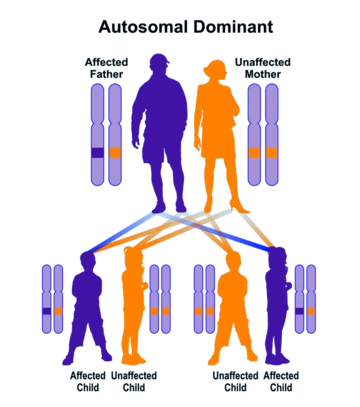
Autosomal dominant inheritance leads to a vertical pattern of transmission