


OMIM ID:
Optic Atrophy with Intellectual Disability
Alternate Names
Defective Genes
Clinical Characteristics
Ocular Features
Optic atrophy is the primary ocular abnormality but visual deficits are said to originate from cortical impairment. The optic discs are pale and may be small with excavation. Strabismus and latent nystagmus are often present. Up slanting palpebral fissures and epicanthal folds have been noted. Visual acuity levels have not been reported.
Systemic Features
Facial dysmorphism of a non-specific pattern can be present as evidenced by protruding ears with helical anomalies, and a small, sometimes elevated nasal bridge. The fingers are small and tapered. Developmental delay is common. Obsessive-compulsive behavior and autistic features have been reported in a single individual. Hypotonia may be present.
Genetics
Inheritance
This is an autosomal dominant disorder resulting from heterozygous mutations in the NR2F1 gene (5q15), a transcription regulator. Six persons with this condition have so far been reported. The gene product is a nuclear protein active in transcription regulation during neurodevelopment.
Pedigree
Autosomal dominant
Autosomal dominant disorders require only one mutation for the disease to be expressed. Since an affected parent has two chromosomes, only one of which has the mutant gene, parents can expect that half (50%) of their children will receive that one and inherit the disease. It is common for individuals that inherit the mutation, however, to not have evidence of the disease (nonpenetrance).
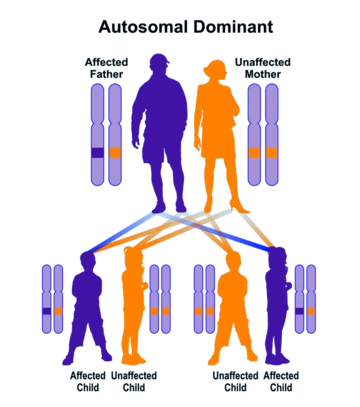
Autosomal dominant inheritance leads to a vertical pattern of transmission