


Clinical Characteristics
Ocular Features
The phenotype in OPA5 has some similarities to that of OPA1 (125250, 165500). Onset occurs as early as the first decade of life in some families but may not be evident until the third decade in other families. Visual acuity decreases slowly and color vision is impaired, more so in older patients. Temporal pallor of the optic nerve is usually present and central scotomas with narrowing of the visual fields can be plotted. The nerve fiber layer is reduced in thickness. VEP defects likewise are variable and generally more severe in later stages. No ERG abnormalities have been reported. This is a bilateral disease with nearly 100% penetrance.
Systemic Features
No systemic abnormalities are present.
Genetics
Inheritance
Heterozygous mutations in the DNM1L gene (12p11.21) are found in patients with OPA5. Morphologic changes found in mitochondria have been interpreted as consistent with an impairment in fission. Two families who had been previously reported to have mutations at the 22q12.1 locus were found to have the DNM1L mutation.
Like several other forms of heritable optic atrophy, OPA1 (125250, 165500) and OPA4 (605293), this is an autosomal dominant disorder.
Pedigree
Autosomal dominant
Autosomal dominant disorders require only one mutation for the disease to be expressed. Since an affected parent has two chromosomes, only one of which has the mutant gene, parents can expect that half (50%) of their children will receive that one and inherit the disease. It is common for individuals that inherit the mutation, however, to not have evidence of the disease (nonpenetrance).
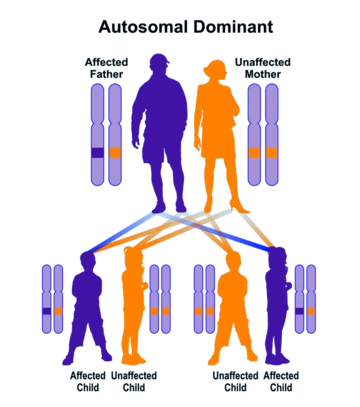
Autosomal dominant inheritance leads to a vertical pattern of transmission