


Clinical Characteristics
Ocular Features
There is considerable variation in age of onset and severity of clinical disease. Cataracts may be evident in the first decade of life but in most cases by the second decade. They are usually described as anterior or posterior cortical opacities. Progression of opacification is slow and most patients do not require removal until late adulthood and some never require surgery. Visual impairment from optic atrophy may be evident in infancy and some patients experience a worsening in late adulthood. Visual acuity is highly variable. Temporal pallor may be present in childhood or later.
Systemic Features
Neurologic signs such as tremor, extrapyramidal rigidity in the upper extremities, and ataxia are seldom present until after the age of 50 years. However not all patients have neurologic disease.
Genetics
Inheritance
This disorder is inherited in an autosomal dominant pattern as a result of a mutation in the OP3 gene (19q13.2-q13.3) encoding an inner membrane mitochondrial protein. It is allelic to autosomal recessive optic atrophy-3, or 3-methylglutaconic aciduria type III (258501), sometimes called Behr early onset optic atrophy (210000).
Optic atrophy 3 is less severe than in Behr optic atrophy and the presence of cataracts is an important distinguishing feature. For these reasons, optic atrophy 3 is discussed as a separate disorder here. However, the nosology remains unclear since not all individuals with Behr optic atrophy have 3-methylglutaric acidemia.
Pedigree
Autosomal dominant
Autosomal dominant disorders require only one mutation for the disease to be expressed. Since an affected parent has two chromosomes, only one of which has the mutant gene, parents can expect that half (50%) of their children will receive that one and inherit the disease. It is common for individuals that inherit the mutation, however, to not have evidence of the disease (nonpenetrance).
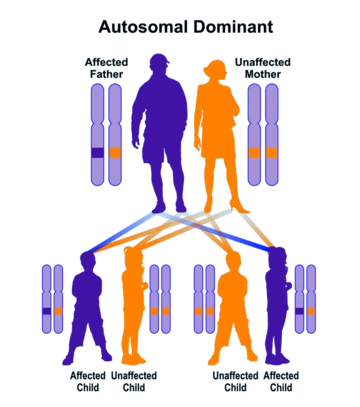
Autosomal dominant inheritance leads to a vertical pattern of transmission