


Clinical Characteristics
Ocular Features
The eyes have been reported as small and sometimes appear deep-set. The epicanthal folds are prominent and the lid fissures are small. Microcornea and evidence of anterior chamber dysplasia including posterior synechiae, anterior displacement of Schwalbe’s line, and stromal hypoplasia in the peripupillary area may be present. Many eyes have some persistence of the pupillary membrane. Nystagmus and strabismus has been seen in some individuals. A few patients have evidence of a persistent hyperplastic primary vitreous, even bilaterally. Cataracts may be present as well and a few patients have been reported with open angle glaucoma. Most patients have normal or near normal visual acuity.
Systemic Features
The clinical features of this syndrome are highly variable. Hair is sparse and the nails are usually dysplastic. The nose appears small and peaked with underdevelopment of the nasal alae, and the mandible may be broad. The cranial bones are often hyperostotic and the long bones as well as the ribs and clavicle are widened. The middle phalanges of the digits are usually hypoplastic or may be absent. Syndactyly of fingers and toes is often a feature and camptodactyly is common. The teeth are small and carious with evidence of enamel dysplasia. Hair often grows slowly and is sparse. A variety of neurological deficits have been reported but no consistent pattern has been recognized. However, white matter lesions and basal ganglia changes have been documented on MRI.
Genetics
Inheritance
Both autosomal recessive and autosomal dominant inheritance have been proposed but in both cases the mutations are in the same gene, GJA1, located at 6q21-q23.2.
This disorder is allelic to Hallermann-Streiff syndrome (234100).
Pedigree
Autosomal dominant
Autosomal dominant disorders require only one mutation for the disease to be expressed. Since an affected parent has two chromosomes, only one of which has the mutant gene, parents can expect that half (50%) of their children will receive that one and inherit the disease. It is common for individuals that inherit the mutation, however, to not have evidence of the disease (nonpenetrance).
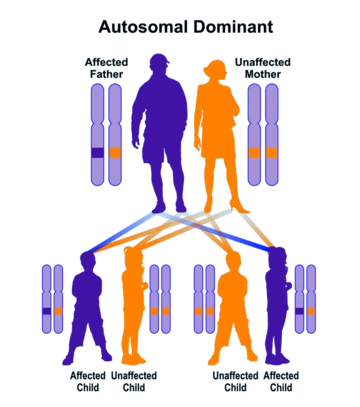
Autosomal dominant inheritance leads to a vertical pattern of transmission
Autosomal recessive
In order for autosomal recessive disorders to be expressed, offspring generally must inherit two mutations, one from each carrier parent. Carriers with only one mutation, such as the parents, do not have clinical disease. Note that carrier parents can expect that 1 in 4 children (25%) will inherit both mutations and have the disorder, 2 in 4 children (50%) will be carriers like their parents, while 1 in 4 children (25%) inherit neither mutation.

In order for autosomal recessive disorders to be expressed, offspring generally must inherit two mutations, one from each carrier parent. Carriers with only one mutation, such as the parents, do not have clinical disease. Note that carrier parents can expect that 1 in 4 children (25%) will inherit both mutations and have the disorder, 2 in 4 children (50%) will be carriers like their parents, while 1 in 4 children (25%) inherit neither mutation.