


Neuronal Ceroid Lipofuscinoses
Alternate Names
Defective Genes
Clinical Characteristics
Ocular Features
At least 13 genotypically distinct forms of neuronal ceroid lipofuscinosis have been described. The ocular features are highly similar in all forms with blindness the end result in all types (although not all cases with an adult onset suffer vision loss). The onset of visual signs and symptoms is highly variable. Optic atrophy is the most common finding which may occur as early as two years of age in the infantile form. Night blindness is a symptom in those with a later onset but panretinal degeneration with unrecordable ERGs eventually occurs. Pigmentary changes throughout the retina are often seen and sometimes occur in a bull’s-eye pattern. Retinal blood vessels may be attenuated and lens opacities of various types are common.
Systemic Features
The neuronal ceroid lipofuscinosis are a group of inherited neurodegenerative lysosomal-storage disorders characterized by the intracellular accumulation of autofluorescent lipopigment causing damage predominantly in the central nervous system. The result is a progressive encephalopathy with cognitive and motor decline, eventual blindness, and seizures with early death. While early descriptions distinguished several types based primarily on age of onset, genotyping has now identified responsible mutations in at least 10 genes and time of onset is no longer considered a reliable indicator of the NCL type.
Genetics
Inheritance
The NCLs are usually inherited in autosomal recessive patterns with the exception of some adult onset cases in which an autosomal dominant pattern is sometimes seen.
The various forms of NCL are often divided according to ages of onset but overlap is common. Thus the congenital form (CLN10; 610127), caused by a mutation in the CTSD gene at 11p15.5, can have an onset of symptoms at or around birth but also is responsible for an adult form (Vida infra). The CLN1 infantile form (256730), caused by a mutation in the PPT1 gene at 1p32, has an onset between 6 and 24 months There are several mutations causing late infantile disease (CLN2, 204500) involving the TPP1 gene (11p15.5) leading to symptoms between 2-4 years, the CLN5 gene (256731) at 13q21.1-q32 with onset between 4 and 7 years, the CLN6 gene (601780) at 15q21-q23 showing symptoms between 18 months and 8 years, and the CLN8 gene (610003) at 8p23 with symptoms beginning between 3 and 7 years. Another early juvenile form (CLN7; 610951) is caused by mutations in MFSD8 (4q228.1-q28.2).
A juvenile form (sometimes called Batten disease or Spielmeyer-Vogt with onset between 4 and 10 years results from mutations in CLN3 (204200) as well as in TPP1, PPT1, and CLN9 (609055). An adult form known as ANCL or Kuf’s disease results from mutations in CTSD, PPT, CLN3, CLN5, and CLN4 (204300) and has its onset generally between the ages of 15 and 50 years.
Homozygous mutations in the ATP13A2 gene (1p36.13), known to cause Kufor-Rakeb type parkinsonism (606693), have also been found in NCL.
Pedigree
Autosomal dominant
Autosomal dominant disorders require only one mutation for the disease to be expressed. Since an affected parent has two chromosomes, only one of which has the mutant gene, parents can expect that half (50%) of their children will receive that one and inherit the disease. It is common for individuals that inherit the mutation, however, to not have evidence of the disease (nonpenetrance).
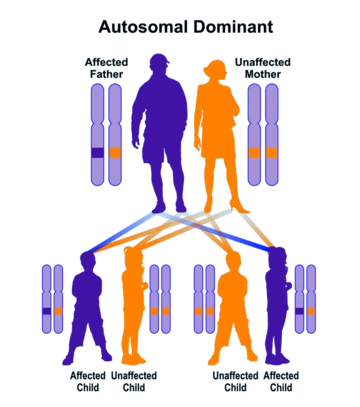
Autosomal dominant inheritance leads to a vertical pattern of transmission
Autosomal recessive
In order for autosomal recessive disorders to be expressed, offspring generally must inherit two mutations, one from each carrier parent. Carriers with only one mutation, such as the parents, do not have clinical disease. Note that carrier parents can expect that 1 in 4 children (25%) will inherit both mutations and have the disorder, 2 in 4 children (50%) will be carriers like their parents, while 1 in 4 children (25%) inherit neither mutation.

In order for autosomal recessive disorders to be expressed, offspring generally must inherit two mutations, one from each carrier parent. Carriers with only one mutation, such as the parents, do not have clinical disease. Note that carrier parents can expect that 1 in 4 children (25%) will inherit both mutations and have the disorder, 2 in 4 children (50%) will be carriers like their parents, while 1 in 4 children (25%) inherit neither mutation.