


OMIM ID:
Mowat-Wilson Syndrome
Alternate Names
Defective Genes
Clinical Characteristics
Ocular Features
Most reports of Mowat-Wilson disorders provide only incomplete ocular findings and the full phenotype remains to be described. Most of the reported findings are part of the facial phenotype, such as downward slanting palpebral fissures, and ‘wedge-shaped’ eyebrows with the medial portion visibly wider than the temporal region. Hypertelorism, strabismus and telecanthus have also been noted. However, optic nerve atrophyor aplasia, RPE atrophy, microphthalmia, ptosis, and cataracts are sometimes present while strabismus is more common. Iris and other uveal colobomas may be present and at least one patient has been reported with retinal aplasia. There may be considerable asymmetry in the features among the two eyes.
Systemic Features
This is a highly complex dysmorphic developmental disorder with unusual progression of facial features. Birth weight and length are usually normal but later there is general somatic and mental growth delay with microcephaly (pre- and post natal), short stature, intellectual disability, and epilepsy (70%). Hypotonia has been noted at birth. A significant proportion (~50%) of patients have Hirschsprung disease with megacolon. Congenital heart defects are common, many involving septal openings. Hypospadias is often present with or without other genitourinary anomalies. Teeth are often crowded and crooked. The earlobes may be flattened and may have a central depression.
The facial features are present in early childhood but as they mature the upper half of the nasal profile becomes convex, while the nasal tip becomes longer and overhangs the philtrum. The eyes appear more deeply set. The chin lengthens and prognathism becomes apparent. IQ levels cannot be determined but many individuals exhibit behavioral or emotional disturbances.
Genetics
Inheritance
Heterozygous mutations in ZEB2 (2q22.3) are responsible for most cases (81%) of this disorder. A large number of molecular mutations, many of the nonsense type, have been reported. About 2-4% of patients have cytogenetic alterations involving the 2q22 region.
Another disorder with microcephaly, intellectual disability and Hirschsprung disease is Goldberg-Shprintzen syndrome (609460) with mutations in the KIAA1279 gene.
Pedigree
Autosomal dominant
Autosomal dominant disorders require only one mutation for the disease to be expressed. Since an affected parent has two chromosomes, only one of which has the mutant gene, parents can expect that half (50%) of their children will receive that one and inherit the disease. It is common for individuals that inherit the mutation, however, to not have evidence of the disease (nonpenetrance).
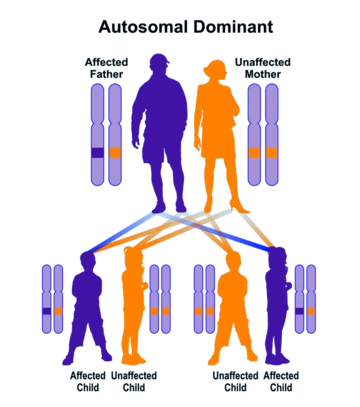
Autosomal dominant inheritance leads to a vertical pattern of transmission