


OMIM ID:
Möebius Syndrome
Alternate Names
Clinical Characteristics
Ocular Features
This is an ill-defined syndrome with the primary features of facial weakness and limited ocular abduction, usually bilateral and nonprogresssive. Those who first described this entity in the 19th century, von Graefe and M√∂ebius, accepted only cases with facial diplegia and bilateral 6th nerve palsy. Since then, however, a large number of associated nerve palsies and systemic malformations have been reported. More than a third of patients have features of Duane’s syndrome. Beyond the oculomotor dysfunction, no ocular abnormalities are consistently associated.
Systemic Features
A large number of neurological and skeletal anomalies have been reported in association with what is called M√∂ebius syndrome. Orofacial dysmorphism, limb malformations and other cranial nerve palsies are the most common. The lack of specific diagnostic criteria for this ‘syndrome’ may explain why many of these associations have been reported, and it is beyond the scope of this database to enumerate or document the validity of including coexistent malformations as part of the M√∂ebius sequence. A significant number of patients have more general motor and coordination disabilities. It is not unusual for young patients to have respiratory difficulties and to suffer an early demise. Necropsy findings often reveal diffuse brainstem pathology.
Genetics
Inheritance
This is either a clinically heterogeneous disorder or a category with multiple disorders. Familial occurrence is uncommon and recurrence risk is generally higher among families with simple 6th and 7th nerve palsies suggesting that cases in which other major anomalies occur are more likely to be the result of environmentally-induced maldevelopment. Both autosomal dominant and autosomal recessive inheritance patterns have been reported in familial cases.
Based on the pattern of chromosomal aberrations found in a multigenerational family, it has been proposed that a locus for Moebius syndrome resides somewhere in 13q12.2-q13.
Pedigree
Autosomal dominant
Autosomal dominant disorders require only one mutation for the disease to be expressed. Since an affected parent has two chromosomes, only one of which has the mutant gene, parents can expect that half (50%) of their children will receive that one and inherit the disease. It is common for individuals that inherit the mutation, however, to not have evidence of the disease (nonpenetrance).
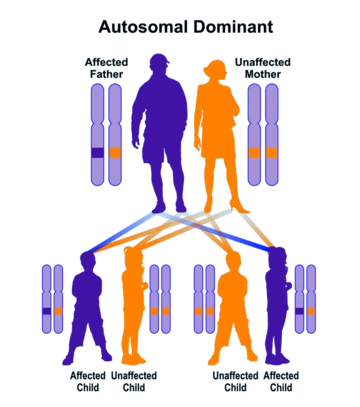
Autosomal dominant inheritance leads to a vertical pattern of transmission
Autosomal recessive
In order for autosomal recessive disorders to be expressed, offspring generally must inherit two mutations, one from each carrier parent. Carriers with only one mutation, such as the parents, do not have clinical disease. Note that carrier parents can expect that 1 in 4 children (25%) will inherit both mutations and have the disorder, 2 in 4 children (50%) will be carriers like their parents, while 1 in 4 children (25%) inherit neither mutation.

In order for autosomal recessive disorders to be expressed, offspring generally must inherit two mutations, one from each carrier parent. Carriers with only one mutation, such as the parents, do not have clinical disease. Note that carrier parents can expect that 1 in 4 children (25%) will inherit both mutations and have the disorder, 2 in 4 children (50%) will be carriers like their parents, while 1 in 4 children (25%) inherit neither mutation.