


Clinical Characteristics
Ocular Features
Isolated microphthalmia with cataract is clinically and genetically heterogeneous and remains to be fully delineated. The cataracts occur congenitally. Nystagmus was an additional feature in several individuals with MCOPCT2. The basis for a third type of microphthalmia with cataract (MCOPCT3) is even less certain but microcornea was also present in several members of a single family. Globe dimensions have not been reported, however, and the criterion for the diagnosis of microphthalmia in reported families is unknown.
Systemic Features
Several patients with MCOPCT1 have had mental retardation.
Genetics
Inheritance
Based on genetic data at least three entities may exist but they are discussed in this database as a group because so few families have been reported. MCOPCT1 follows an autosomal dominant pattern and segregates with a single unknown mutation at 16p13.3. Another family with a reciprocal translocation t(2;16)(p22.3;p13.3) involving a breakpoint in the 16p13.3 region seems to support the idea that an altered gene in this location is responsible for the phenotype. MCOPCT2 also usually follows an autosomal dominant pattern and seems to be caused by mutations in the SIX6 gene (14q23.1). The mode of inheritance in MCOPCT3 is uncertain since the transmission pattern in one family suggested X-linked dominance while in another family only males were affected. No mutation or locus has been identified.
Pedigree
Autosomal dominant
Autosomal dominant disorders require only one mutation for the disease to be expressed. Since an affected parent has two chromosomes, only one of which has the mutant gene, parents can expect that half (50%) of their children will receive that one and inherit the disease. It is common for individuals that inherit the mutation, however, to not have evidence of the disease (nonpenetrance).
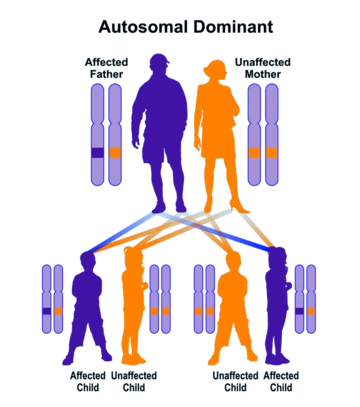
Autosomal dominant inheritance leads to a vertical pattern of transmission