


Clinical Characteristics
Ocular Features
Isolated colobomatous microphthalmia is uncommon compared with the syndromal conditions of which there are more than 100. The clinical findings are confined to the eye in this condition. The globe is abnormally small (defined by some as less than 20 mm in length in at least one eye). Incomplete penetrance and variable expression are typical but often the cornea is small and may be cloudy with anterior synechiae suggesting that anterior chamber dysgenesis may also be a feature in some cases. One or both eyes may be involved. Visual acuity depends on the structures involved.
It is not uncommon for other ocular abnormalities to occur in association with the malformed globes, such as cataracts, microcornea, sclerocornea and optic nerve dysplasia.
Systemic Features
None.
Genetics
Inheritance
The majority of isolated microphthalmos with coloboma are inherited in an autosomal dominant pattern [see also microphthalmia with coloboma, X-linked (MCOPCB1; 300345)]. Reports are mostly of single kinships. At least 5 additional genes are involved: MCOPCB2 (605738) results from mutations in a locus at 15q12-q15, MCOPCB3 (610092) is caused by mutations in the CHX10 (VSX2) gene (14q24), MCOPCB4 (251505) frequently has a cystic malformation as well and is likely an autosomal recessive condition but the mutation and its location remain unknown, MCOPCB5 (611638) is caused by a mutation in SHH (7q36), and MCOPCB6 (613703) results from mutations in the GDF3 gene (12p13.1).
For an X-linked form of non-syndromic microphthalmia with coloboma, see Microphthalmia with Coloboma (300345 ). For a syndromal form of X-linked microphthalmia, see Microphthalmia, Syndromic 1 (309800 ).
Pedigree
Autosomal dominant
Autosomal dominant disorders require only one mutation for the disease to be expressed. Since an affected parent has two chromosomes, only one of which has the mutant gene, parents can expect that half (50%) of their children will receive that one and inherit the disease. It is common for individuals that inherit the mutation, however, to not have evidence of the disease (nonpenetrance).
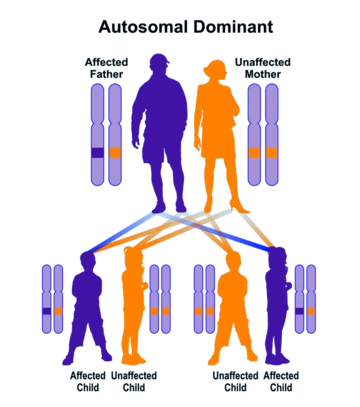
Autosomal dominant inheritance leads to a vertical pattern of transmission
Autosomal recessive
In order for autosomal recessive disorders to be expressed, offspring generally must inherit two mutations, one from each carrier parent. Carriers with only one mutation, such as the parents, do not have clinical disease. Note that carrier parents can expect that 1 in 4 children (25%) will inherit both mutations and have the disorder, 2 in 4 children (50%) will be carriers like their parents, while 1 in 4 children (25%) inherit neither mutation.

In order for autosomal recessive disorders to be expressed, offspring generally must inherit two mutations, one from each carrier parent. Carriers with only one mutation, such as the parents, do not have clinical disease. Note that carrier parents can expect that 1 in 4 children (25%) will inherit both mutations and have the disorder, 2 in 4 children (50%) will be carriers like their parents, while 1 in 4 children (25%) inherit neither mutation.