


OMIM ID:
Mental Retardation, AD 34
Alternate Names
Defective Genes
Clinical Characteristics
Ocular Features
Patients may have upslanting lid fissures, epicanthus, ptosis, synophrys, and cortical visual impairment.
Systemic Features
Among the three reported individuals with the COL4A3BP mutation, one had postnatal microcephaly, widely spaced teeth, synophrys, and intellectual disability. Another had trunk hypotonia, global developmental delay, wide intermamillary distance, 2-3 toe syndactyly, tonic-clonic seizures, and myopathic facies. The third had a broad-based gait, coarse and curly hair, tonic-clonic seizures, and global developmental delay.
Genetics
Inheritance
In a screening study of 1133 children with severe undiagnosed developmental conditions, three males were found with heterozygous mutations in the COL4A3BP gene (5q13). Family history data are not given for these three individuals but autosomal dominant transmission seems to be a reasonable assumption.
Pedigree
Autosomal dominant
Autosomal dominant disorders require only one mutation for the disease to be expressed. Since an affected parent has two chromosomes, only one of which has the mutant gene, parents can expect that half (50%) of their children will receive that one and inherit the disease. It is common for individuals that inherit the mutation, however, to not have evidence of the disease (nonpenetrance).
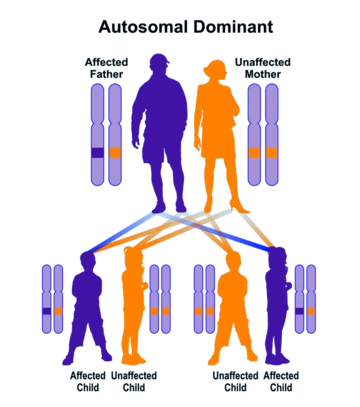
Autosomal dominant inheritance leads to a vertical pattern of transmission