


OMIM ID:
Mandibulofacial Dysostosis with Alopecia
Alternate Names
Defective Genes
Clinical Characteristics
Ocular Features
The extensive dysplasia of the facial bones involves those of the orbital rims and zygomatic arches. The orbital rims can be malformed and there is often a broad depression at the inferolateral region of the eyes. Hypoplasia or even aplasia of the eyelids maybe present and some individuals have colobomas of the lower eyelids. The lacrimal punctae may be temporally displaced. The eyebrows and eyelashes are often sparse as part of the generalized alopecia.
Systemic Features
This is a disorder of craniofacial development resulting in extensive malformations of facial bones and skin. Different rates of development among these structures leads to facial asymmetry in many patients. Maxillary, zygomatic arch, and mandibular bones are dysplastic resulting in micrognathia and a flat midface. The temporomandibular joints are absent and the external ear canals are often incompletely formed. Conductive hearing loss is common with hypoplastic ossicular chains while the pinnae are low-set, crumpled and abnormally cupped. There may be preauricular tags or pits present. Tooth eruption is often delayed and there may be agenesis of many permanent teeth. The maxillary sinuses may be absent. Cleft palate is often present.
Genetics
Inheritance
Heterozygous mutations in the EDNRA gene (4q31) are responsible for this condition. No familial cases have been reported and it can be assumed that the mutations arise de novo.
Pedigree
Autosomal dominant
Autosomal dominant disorders require only one mutation for the disease to be expressed. Since an affected parent has two chromosomes, only one of which has the mutant gene, parents can expect that half (50%) of their children will receive that one and inherit the disease. It is common for individuals that inherit the mutation, however, to not have evidence of the disease (nonpenetrance).
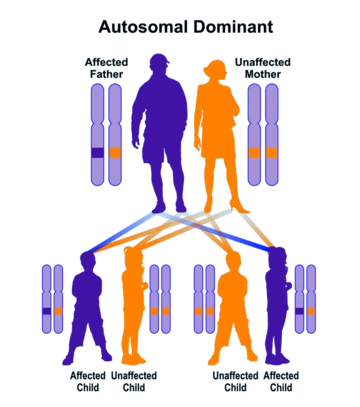
Autosomal dominant inheritance leads to a vertical pattern of transmission