


OMIM ID:
Leber Congenital Amaurosis with Early-Onset Deafness
Alternate Names
Defective Genes
Clinical Characteristics
Ocular Features
Evidence for retinal disease can be seen within 3 years of age. Three of 5 patients had no detectable responses on the ERG when tested at birth. A 34-year-old female was noted to have advanced retinitis pigmentosa with attenuation of retinal vessels, choroidal atrophy, peripheral pigmentary deposits, and macular anomalies. The posterior fundus may have a salt-and-pepper pigmentation. Hypermetropia was present in all 5 patients.
Visual acuity varies widely and may be normal even among older patients.
Systemic Features
Mild to severe sensorineural hearing loss secondary to cochlear cell loss is usually diagnosed in the first decade. All patients had normal neuro-psychomotor development.
Genetics
Inheritance
Heterozygous mutations in the TUBB4B gene (9q34.3) have been found in 5 individuals in 4 families with this disorder. There may be significant mosaicism in blood cells.
See Leber Congenital Amaurosis for additional information on non-syndromal Leber congenital amaurosis and responsible mutations.
Pedigree
Autosomal dominant
Autosomal dominant disorders require only one mutation for the disease to be expressed. Since an affected parent has two chromosomes, only one of which has the mutant gene, parents can expect that half (50%) of their children will receive that one and inherit the disease. It is common for individuals that inherit the mutation, however, to not have evidence of the disease (nonpenetrance).
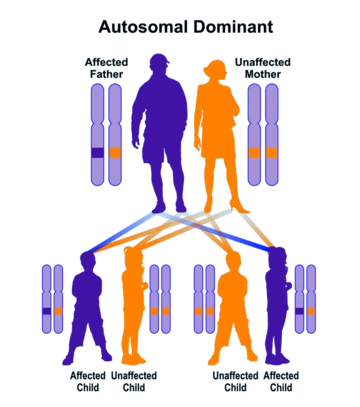
Autosomal dominant inheritance leads to a vertical pattern of transmission