


Clinical Characteristics
Ocular Features
High myopia and vitreoretinal degeneration are characteristic ocular features in this disorder. The myopia is in the range of -7.5 to -15.25 with most patients having about -11 diopters. Acuity may be normal but inoperable retinal detachments can lead to blindness. The vitreous demonstrates liquefaction and syneresis and often detaches posteriorly forming a retrolental curtain. About half of affected eyes have perivascular lattice degeneration and the same proportion of patients at some point develop a retinal detachment. Giant tears and retinal dialysis are commonly the cause. The lens is often dislocated and cataracts are common.
Systemic Features
Short stature, cleft palate, stiff joints, and conductive hearing loss are characteristic extraocular features of Kniest dysplasia. Some patients develop frank joint contractures and many are unable to make a tight fist due to inflexibility of the interphalangeal joints. Lumber kyphoscoliosis is common. Epiphyseal cartilage has a ‘Swiss cheese appearance’ with prominent lacunae. The facies are round and the midface is underdeveloped with a flat nasal bridge. Mild psychomotor retardation is sometimes seen.
High levels of keratin sulfate are found in the urine.
Genetics
Inheritance
Mutations in the COL2A1 gene (12q13.11-q13.2) coding for type II collagen is responsible for this autosomal dominant disorder. This is one of a number of disorders known as type II collagenopathies (see Stickler syndrome I [609508]). The clinical features arise from a defect in type II procollagen.
Pedigree
Autosomal dominant
Autosomal dominant disorders require only one mutation for the disease to be expressed. Since an affected parent has two chromosomes, only one of which has the mutant gene, parents can expect that half (50%) of their children will receive that one and inherit the disease. It is common for individuals that inherit the mutation, however, to not have evidence of the disease (nonpenetrance).
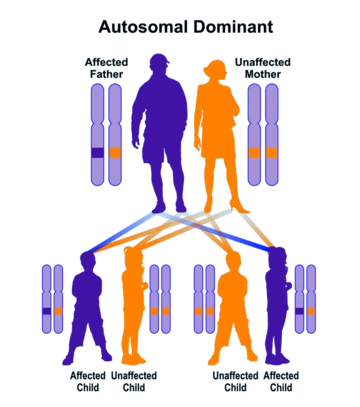
Autosomal dominant inheritance leads to a vertical pattern of transmission