


OMIM ID:
Keratosis Follicularis Spinulosa Decalvans, X-Linked
Alternate Names
Defective Genes
Clinical Characteristics
Ocular Features
There is alopecia of the eyelashes and eyebrows. The skin of the eyelids is thickened often with an associated chronic blepharitis followed by entropion (ectropion sometimes mentioned). Photophobia and keratitis with ‘corneal degeneration’ are also features but it is unknown whether these are primary or secondary to trichiasis from the eyelid deformities. The corneal findings usually precede the scarring alopecia of the scalp.
Systemic Features
Onset is in childhood. Thickening of skin is generalized especially in the neck, ears, and the extremities with marked involvement of the palms and soles, especially in the calcaneal regions. Scalp hair may be sparse, often in a streak pattern. The follicles are inflamed and hyperkeratotic resulting in scarring alopecia. Carriers have been reported to have dry skin with mild follicular hyperkeratosis and more extensive involvement of the soles.
Genetics
Inheritance
This is a rare disorder with genetic and clinical heterogeneity. The majority of cases seem to be inherited in an X-linked recessive pattern secondary to mutations in the SAT1 gen located at Xp22.1.
However, multigenerational families with male to male transmission have also been reported suggesting autosomal dominant inheritance (KFSD; 612843). However, no associated mutations or loci have been reported for this condition.
Pedigree
Autosomal dominant
Autosomal dominant disorders require only one mutation for the disease to be expressed. Since an affected parent has two chromosomes, only one of which has the mutant gene, parents can expect that half (50%) of their children will receive that one and inherit the disease. It is common for individuals that inherit the mutation, however, to not have evidence of the disease (nonpenetrance).
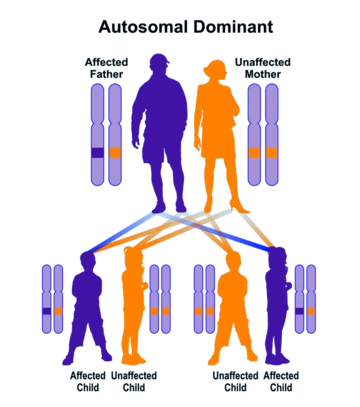
Autosomal dominant inheritance leads to a vertical pattern of transmission
X-linked recessive, carrier mother
X-linked disorders are caused by a mutation on the X chromosome and both sexes can pass this to their children. If the mutation is in a recessive gene and carried by the mother, she usually does not have the disease since the normal X chromosome without the mutation neutralizes the mutation in the abnormal X chromosome. However, half her sons will inherit the mutation-containing X chromosome and therefore have the X-linked disease. Half the daughters will inherit the mutation-bearing X chromosome and are usuallly healthy 'carriers'.

X-linked disorders are caused by a mutation on the X chromosome and both sexes can pass this to their children. If the mutation is in a recessive gene and carried by the mother, she usually does not have the disease since the normal X chromosome without the mutation neutralizes the mutation in the abnormal X chromosome. However, half her sons will inherit the mutation-containing X chromosome and therefore have the X-linked disease. Half the daughters will inherit the mutation-bearing X chromosome and are usuallly healthy 'carriers'.
X-linked recessive, father affected
X-linked disorders are caused by a mutation on the X chromosome and both sexes can pass this to their children. If the mutation is in a recessive gene and carried by the father, he has the disease since his only X chromosome is mutant and he has no normal X to blunt the effects of the abnormal gene. His sons only receive his Y chromosome and thus are all normal. However, all his daughters receive his one and only X chromosome and will be healthy 'carriers'. Thus such males will have no affected children but half their grandsons from those daughters will have the same disease as he does.

X-linked disorders are caused by a mutation on the X chromosome and both sexes can pass this to their children. If the mutation is in a recessive gene and carried by the father, he has the disease since his only X chromosome is mutant and he has no normal X to blunt the effects of the abnormal gene. His sons only receive his Y chromosome and thus are all normal. However, all his daughters receive his one and only X chromosome and will be healthy 'carriers'. Thus such males will have no affected children but half their grandsons from those daughters will have the same disease as he does.