


OMIM ID:
Keratoendotheliitis Fugax Hereditaria
Alternate Names
Defective Genes
Clinical Characteristics
Ocular Features
Recurrent ocular inflammatory episodes begin between the ages of 3 and 12 years (median age of onset 11 years). These episodes can last from a few days to several weeks and may recur several times a year. Episodes are milder and less frequent in older individuals. There is often conjunctival hyperemia accompanied by pain, blurry vision, and photophobia during the acute phase. In addition, the posterior stroma is edematous and hazy, pseudoguttata may be present, and some patients have a mild anterior chamber reaction. Visual acuity is normal in most individuals but may be mildly reduced during acute attacks or rarely in older patients with central corneal opacities. Occasional corneal erosions have been reported. Between attacks the endothelial cells can appear normal.
Systemic Features
No systemic features have been found.
Genetics
Inheritance
Heterozygous mutations in the NLRP3 gene (1q44) encoding cryopyrin have been identified in European (Finnish) populations with this disorder.
Pedigree
Autosomal dominant
Autosomal dominant disorders require only one mutation for the disease to be expressed. Since an affected parent has two chromosomes, only one of which has the mutant gene, parents can expect that half (50%) of their children will receive that one and inherit the disease. It is common for individuals that inherit the mutation, however, to not have evidence of the disease (nonpenetrance).
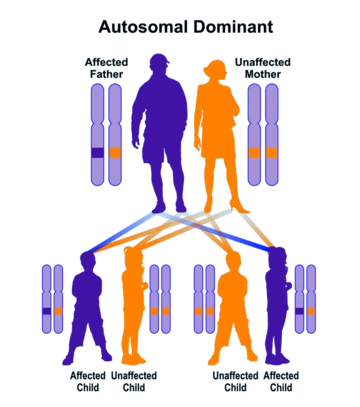
Autosomal dominant inheritance leads to a vertical pattern of transmission