


Clinical Characteristics
Ocular Features
Clinical information on one patient suggests that vision loss is first noted in the mid-teens and may be severe by age 23 years. Classical signs of keratoconus including corneal thinning, corneal ectasia, and a cone-shaped protrusion with Vogt’s striae and a Fleischer’s ring were present bilaterally.
Systemic Features
No associated systemic abnormalities have been reported.
Genetics
Inheritance
Heterozygous mutations in the TUBA3D gene (2q21.1) have been found in 4 patients including monozygotic twin females. The mutation was not found in the parents of the twin sisters which suggests that the mutations arose de novo. Other mutations in the same gene have been found in two more unrelated individuals with keratoconus.
Other forms of hereditary keratoconus caused by different mutations are: KTCN1 (148300) mapped to a mutation in the VSX1 gene at 20p11, KTCN2 (608932) linked to a mutation on chromosome 16 (16q22.3-q23.1), KTCN3 (608586) by a mutation on chromosome 3 (3p14-q13), KTCN4 (609271) caused by a mutation on chromosome 2 (2p24), KTCN5 (614622) mapped to 5q14.1-q21.3, KTCN6 (614623) mapped to 9q34, KTCN7 (614629) mapped to 13q32, and KTCN8 (614628) mapped to 14q24.
Pedigree
Autosomal dominant
Autosomal dominant disorders require only one mutation for the disease to be expressed. Since an affected parent has two chromosomes, only one of which has the mutant gene, parents can expect that half (50%) of their children will receive that one and inherit the disease. It is common for individuals that inherit the mutation, however, to not have evidence of the disease (nonpenetrance).
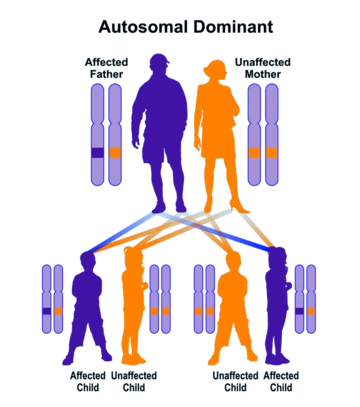
Autosomal dominant inheritance leads to a vertical pattern of transmission