


OMIM ID:
Kaufman Oculocerebrofacial Syndrome
Alternate Names
Defective Genes
Clinical Characteristics
Ocular Features
Alterations in the morphology of periocular structures is the most consistent ocular feature. These include epicanthal folds, upward-slanting lid fissures, ptosis, blepharophimosis, sparse eyebrows, and telecanthus. However, pale optic discs, iris colobomas, microcornea, strabismus, nystagmus, and hypertelorism are variably present.
Systemic Features
There is both intrauterine and postnatal growth retardation. Hypotonia is often noted along with general psychomotor delays. Neonatal respiratory distress and laryngeal stridor may be present. The intellectual disability can be severe. Corpus callosum aplasia and hypoplasia have been reported. Microcephaly and brachycephaly with delayed suture closure are features. The face is long and narrow and the mouth is disproportionally large. A high arched palate can be present and the pinnae are often deformed, posteriorly rotated and may be accompanied by preauricular skin tags. The teeth appear widely spaced (diastema) and the lower jaw is underdeveloped.
Genetics
Inheritance
Kaufman BPIDS syndrome results from homozygous or compound heterozygous mutations in the UBE3B gene (12q23).
Pedigree
Autosomal dominant
Autosomal dominant disorders require only one mutation for the disease to be expressed. Since an affected parent has two chromosomes, only one of which has the mutant gene, parents can expect that half (50%) of their children will receive that one and inherit the disease. It is common for individuals that inherit the mutation, however, to not have evidence of the disease (nonpenetrance).
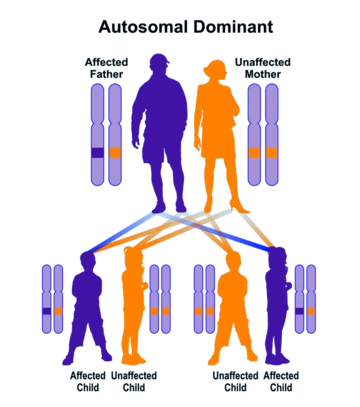
Autosomal dominant inheritance leads to a vertical pattern of transmission