


OMIM ID:
Hypotrichosis-Lymphedema-Telangiectasia-Renal Defect Syndrome
Alternate Names
Defective Genes
Clinical Characteristics
Ocular Features
Sparse hair can be noted at birth and by several years of age the alopecia of the eyelids and eyebrows is complete. The upper eyelids may be swollen at birth as well.
Systemic Features
The facial features are unusual. The nose appears long and may have a broad nasal root. The lips are full and the lower jaw is prominent. Evidence of developmental delay has been reported in one patient.
The scrotum can be edematous at birth and sometimes contains large hydroceles. Hair is sparse in infancy but within a few years alopecia is complete. Telangiectases on the scalp, scrotum, and limbs are evident at several years of age. Pulmonary vascular congestion and lymphangiectasia may be present in some individuals antenatally. Renal failure, sometimes with hypertension can occur at any time from early childhood to young adulthood. Renal biopsy has shown histologic features consistent with membranoproliferative glomerulonephritis and thrombotic microangiopathy. This may be preceded by proteinuria in infants as young as 2 years.
Genetics
Inheritance
Pedigree
Autosomal dominant
Autosomal dominant disorders require only one mutation for the disease to be expressed. Since an affected parent has two chromosomes, only one of which has the mutant gene, parents can expect that half (50%) of their children will receive that one and inherit the disease. It is common for individuals that inherit the mutation, however, to not have evidence of the disease (nonpenetrance).
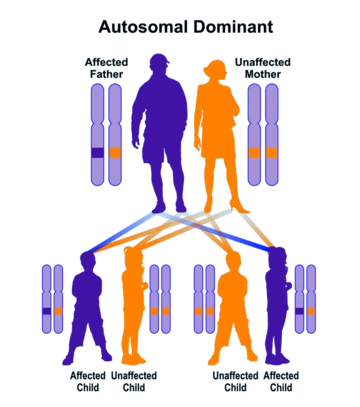
Autosomal dominant inheritance leads to a vertical pattern of transmission