


OMIM ID:
Hyperferritinemia-Cataract Syndrome
Alternate Names
Defective Genes
Clinical Characteristics
Ocular Features
Lens opacification is the only ocular sign of this disorder. These may be congenital and nuclear in location but this is variable. Pulverulent and ‘sunflower’ light-diffracting opacities have also been described and are likely responsible for the glare that many patients experience. In some patients cataracts may not be diagnosed until adult life. Ferritin levels in surgically removed lenses are 1,500 times higher than controls and histochemical studies demonstrate that the crystalline lens opacities consist of intracellular L-ferritin.
Systemic Features
Serum levels of iron and transferrin saturation are normal but ferritin levels are high. Most patients are asymptomatic but blood loss may lead to iron deficiency anemia.
Genetics
Inheritance
This is an autosomal dominant disorder resulting from mutations in the FTL gene located at 19q33.33. Phenotypic variability is common as expressed by serum ferritin levels and the characteristics of the lens opacities.
A patient with homozygosity of the FTL mutation has been reported but the phenotype resembled that of heterozygous patients.
Cataracts may also be present among other disorders of iron metabolism. For example, mutations in the gene HFE (6p21.3) that is responsible for a form of hemachromotosis (235200), can also be associated with lens opacities consisting of both general nuclear sclerosis and discrete opacities. Epilepsy may be part of the phenotype as well.
Pedigree
Autosomal dominant
Autosomal dominant disorders require only one mutation for the disease to be expressed. Since an affected parent has two chromosomes, only one of which has the mutant gene, parents can expect that half (50%) of their children will receive that one and inherit the disease. It is common for individuals that inherit the mutation, however, to not have evidence of the disease (nonpenetrance).
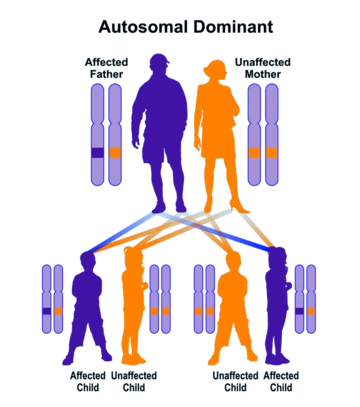
Autosomal dominant inheritance leads to a vertical pattern of transmission