


OMIM ID:
Hereditary Mucoepithelial Dysplasia
Alternate Names
Defective Genes
Clinical Characteristics
Ocular Features
Impaired epithelial cohesion is the fundamental defect in this disorder. Photophobia may be present in infants and this is soon evident as secondary to keratitis with eventual formation of a pannus and corneal neovascularization. Vision is impaired early and as the disease progresses, many patients by early adulthood are severely impaired. Cataracts are present in the majority of individuals, often present as early as the second decade of life. Eyelashes and eyebrows may be sparse. Nystagmus has been reported in some patients.
Systemic Features
This is a panepithelial disease of impaired cohesion due, at least in part, to a reduced number of desmosomes and defective gap junctions. Oral, nasal, vaginal, cervical, perineal, urethral, and bladder mucosa, in addition to external ocular surfaces, are involved. With exception of the ocular involvement, the lesions are usually not painful, but may be during acute flare-ups. Demarcated erythematous patches are often seen in the oral mucosa. Non-scarring alopecia, keratosis pilaris, and perineal intertrigo are usually present. Histological examination of oral mucosa and skin shows dyskeratotic features, decreased number of desmosomes, and intracytoplasmic vacuoles.
Genetics
Inheritance
Pedigrees suggest autosomal dominant inheritance but few families have been reported. The location of the responsible mutation, if any, has not been found.
Somewhat similar genodermatoses are KID syndrome (148210), an autosomal dominant disorder with neurosensory hearing loss and sometimes mental and physical delays secondary to mutations in GJB2, and IFAP (308205), an X-linked condition with mental and physical delays and severe organ deformities. Cataracts are not features of KID or IFAP syndromes.
Pedigree
Autosomal dominant
Autosomal dominant disorders require only one mutation for the disease to be expressed. Since an affected parent has two chromosomes, only one of which has the mutant gene, parents can expect that half (50%) of their children will receive that one and inherit the disease. It is common for individuals that inherit the mutation, however, to not have evidence of the disease (nonpenetrance).
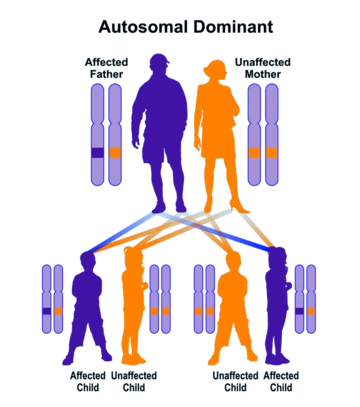
Autosomal dominant inheritance leads to a vertical pattern of transmission