


OMIM ID:
Feingold Syndrome 1
Alternate Names
Defective Genes
Clinical Characteristics
Ocular Features
Short, narrow palpebral fissures have been reported (73%). The fissures may be up slanting and epicanthal folds have been noted.
Systemic Features
The face can appear asymmetrical and triangular and the head is small in 89% of individuals. Micrognathia is usually present and the lips appear full. The nasal bridge is broad and the nostrils are anteverted. The ears are often low-set and rotated posteriorly. Syndactyly of the toes is common (97%) and the fingers are often anomalous (particularly 5th finger clinodactyly and brachydactyly) with hypoplastic thumbs. Shortening of the 2nd and 5th middle phalanx of the fingers is especially common. True short stature is uncommon but 60% are below the 10th centile. Rare individuals have a sensorineural hearing loss.
Tracheoesophageal fistulas are often present, together with atresia of the duodenum and sometimes the esophagus as well. Cardiac, renal, and vertebral malformations are seen in a minority of patients.
Intelligence may be normal but more often is below average and learning difficulties are often present.
Genetics
Inheritance
Pedigree
Autosomal dominant
Autosomal dominant disorders require only one mutation for the disease to be expressed. Since an affected parent has two chromosomes, only one of which has the mutant gene, parents can expect that half (50%) of their children will receive that one and inherit the disease. It is common for individuals that inherit the mutation, however, to not have evidence of the disease (nonpenetrance).
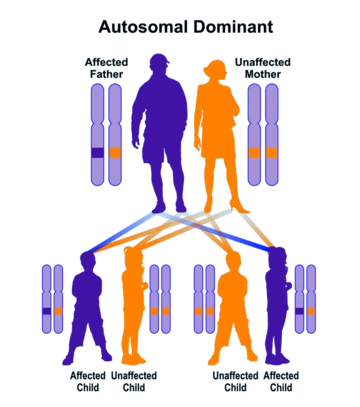
Autosomal dominant inheritance leads to a vertical pattern of transmission