


OMIM ID:
Familial Exudative Vitreoretinopathy, EVR6
Alternate Names
Defective Genes
Clinical Characteristics
Ocular Features
Clinical features of this type of exudative retinopathy are based upon the findings in a single large Dutch pedigree containing 16 affected individuals. The age of onset is unknown but this condition has been described in a 3 year old. Characteristics of FEVR6 are often seen in individuals during the second or third decades when decreasing vision becomes a challenge. While some individuals can have normal acuity, others have severe vision loss, often to finger-counting range.
Ocular findings are limited to the fundus consisting of areas of hypo- or hyperpigmentation, dragging of the macula, peripheral retinal avascularity, leaky and stretched capillaries, and exudates. There may be falciform retinal folds and detachments. Some patients have white masses of fibrous tissue in or overlying the retina. Cataracts have been described in several patients.
Systemic Features
No systemic abnormalities have been reported.
Genetics
Inheritance
FEVR6 results from heterozygous mutations in the ZNF408 gene (11p11.2). Homozygous mutations in the same gene are responsible for retinitis pigmentosa 72 (616469).
Pedigree
Autosomal dominant
Autosomal dominant disorders require only one mutation for the disease to be expressed. Since an affected parent has two chromosomes, only one of which has the mutant gene, parents can expect that half (50%) of their children will receive that one and inherit the disease. It is common for individuals that inherit the mutation, however, to not have evidence of the disease (nonpenetrance).
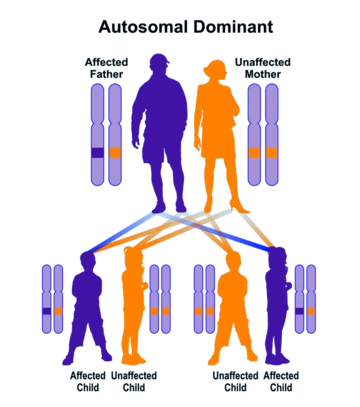
Autosomal dominant inheritance leads to a vertical pattern of transmission