


OMIM ID:
Familial Exudative Vitreoretinopathy, EVR3
Alternate Names
Defective Genes
Clinical Characteristics
Ocular Features
Abnormal retinal angiogenesis with retinal ischemia is the development defect that leads to the clinical features of the familial exudative vitreoretinopathies. It is usually bilateral. There is considerable clinical heterogeneity in the appearance of both the retina and the vitreous but common to all is the presence of peripheral areas of avascularity in the retina that may be seen in newborns. This may only be visible using fluorescein angiography in mild cases. The vessels may be hyperpermeable resulting in patchy exudates in the retina. Neovascularization often develops with retinal and vitreous bleeding and eventually retinal traction resulting in retinal folds and detachments. Severe disease with early onset may result in blindness in infants but milder disease may be asymptomatic even as adults. Cataracts may result.
The ocular disease may be confused with retinal dysplasia (as seen in pseudogliomas and Norrie disease [310600]) or retinopathy of prematurity.
Systemic Features
No systemic features have been reported in EVR3.
Genetics
Inheritance
Pedigree
Autosomal dominant
Autosomal dominant disorders require only one mutation for the disease to be expressed. Since an affected parent has two chromosomes, only one of which has the mutant gene, parents can expect that half (50%) of their children will receive that one and inherit the disease. It is common for individuals that inherit the mutation, however, to not have evidence of the disease (nonpenetrance).
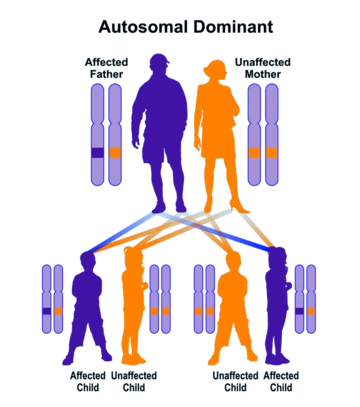
Autosomal dominant inheritance leads to a vertical pattern of transmission