


OMIM ID:
Eye Movement Disorders with CACNA1A Mutations
Defective Genes
Clinical Characteristics
Ocular Features
Eye movement disorders secondary to CACNA1A mutations include congenital nystagmus, abnormal saccades and paroxysmal tonic upgaze and can be early indicators of underlying neurologic disease. The median age of presentation in one series was 1.2 years.
Systemic Features
Eye movement disorders form a group of conditions that may occur in isolation but can also be associated with underlying neurological disease (vida infra).
Genetics
Inheritance
Heterozygous mutations in the CACNA1A gene (19p13.13) have been associated with a number of conditions including type 2 episodic ataxia (108500), familial hemiplegic migraine 1 (141500), and 2 (602481), spinocerebellar ataxia 6 (183086), and several types of eye movement disorders including congenital nystagmus, abnormal saccades, and paroxysmal tonic upgaze.
The gene product is a transmembrane pore-forming subunit of a voltage-gated calcium channel expressed abundantly in neuronal tissue.
Pedigree
Autosomal dominant
Autosomal dominant disorders require only one mutation for the disease to be expressed. Since an affected parent has two chromosomes, only one of which has the mutant gene, parents can expect that half (50%) of their children will receive that one and inherit the disease. It is common for individuals that inherit the mutation, however, to not have evidence of the disease (nonpenetrance).
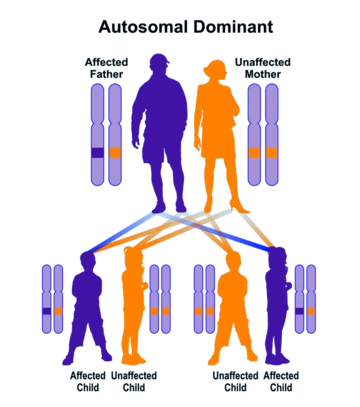
Autosomal dominant inheritance leads to a vertical pattern of transmission