


Clinical Characteristics
Ocular Features
Progressive external ophthalmoplegia of these types is often associated with widespread neurological and muscle manifestations. The ophthalmoplegia is adult in onset and frequently combined with exercise intolerance. Significant lens opacities may be seen in early childhood but may not cause vision problems until early adulthood. Progressive ptosis is often an early and disabling sign.
Systemic Features
Facial muscles can be weak, generally in older individuals. Some patients complain of dysphagia. Sensoirneural hearing loss, dysarthria, and dysphonia are often associated. Neurological symptoms include ataxia, sensory neuropathy, tremors, depression and symptoms of parkinsonism but these are variable. Some patients experience rhabdomyolysis following alcohol consumption. Dilated cardiomyopathy can be a part of the autosomal recessive form of this disease.
A possible subcategory of this disease is associated with hypogonadism evidenced by delayed sexual maturation, primary amenorrhea, early menopause and testicular atrophy. Other features as described above may be associated. Muscle biopsy shows ragged-red fibers with multiple mitochondrial deletions.
Genetics
Inheritance
Progressive external ophthalmoplegia of the type described here is the result of mutations in the autosomal gene POLG combined with deletions in mitochondrial DNA. POLG mutations account for 13-45% of patients with progressive external ophthalmoplegia who also have mitochondrial deletions. The inheritance pattern in some families resembles the classical autosomal dominant pattern (PEOA1, 157640) whereas in others the pattern suggests autosomal recessive transmission (PEOB, 258450). The autosomal defect is in the POLG gene at locus 15q25 which codes for the nuclear-encoded DNA polymerase-gamma gene. The phenotype in the recessive disease tends to be more severe than in autosomal dominant cases.
Other autosomal mutations with a less complex clinical picture associated with ophthalmoplegia are located in genes ANT1 (SLC25A4) (609283) at 4q35, and C10ORF2 (606075) at 10q24.
Pedigree
Autosomal dominant
Autosomal dominant disorders require only one mutation for the disease to be expressed. Since an affected parent has two chromosomes, only one of which has the mutant gene, parents can expect that half (50%) of their children will receive that one and inherit the disease. It is common for individuals that inherit the mutation, however, to not have evidence of the disease (nonpenetrance).
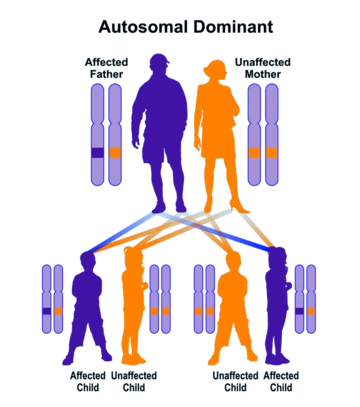
Autosomal dominant inheritance leads to a vertical pattern of transmission
Autosomal recessive
In order for autosomal recessive disorders to be expressed, offspring generally must inherit two mutations, one from each carrier parent. Carriers with only one mutation, such as the parents, do not have clinical disease. Note that carrier parents can expect that 1 in 4 children (25%) will inherit both mutations and have the disorder, 2 in 4 children (50%) will be carriers like their parents, while 1 in 4 children (25%) inherit neither mutation.

In order for autosomal recessive disorders to be expressed, offspring generally must inherit two mutations, one from each carrier parent. Carriers with only one mutation, such as the parents, do not have clinical disease. Note that carrier parents can expect that 1 in 4 children (25%) will inherit both mutations and have the disorder, 2 in 4 children (50%) will be carriers like their parents, while 1 in 4 children (25%) inherit neither mutation.