


OMIM ID:
Dyskeratosis, Hereditary Benign Intraepithelial
Alternate Names
Defective Genes
Clinical Characteristics
Ocular Features
The conjunctival surface has elevated, granular-appearing white epithelial plaques usually in the interpalpebral areas. These may extend onto the cornea and cause interference with vision. The plaques may also shed spontaneously. The lesions may have prominent blood vessels with associated conjunctival hyperemia with considerable cosmetic implications.
The plaque-like growths remain localized and do not invade tissue. The surface epithelium is hyperkeratotic with acanthosis and individual cell dyskeratoses.
Systemic Features
The oral and lingual mucosa may also be involved.
Genetics
Inheritance
A segment of DNA localized at 4q35 is duplicated resulting in triple alleles for 2 linked markers suggesting that gene duplication is responsible for the disorder. It occurs almost exclusively among members of a triracial isolate (Haliwa Indians) in North Carolina.
Families with autosomal dominant transmission have been reported. In one French Canadian family in which mother and son were affected a nonsense mutation in NLRP1 (17p13.2) was found. This may be a unique disorder.
Pedigree
Autosomal dominant
Autosomal dominant disorders require only one mutation for the disease to be expressed. Since an affected parent has two chromosomes, only one of which has the mutant gene, parents can expect that half (50%) of their children will receive that one and inherit the disease. It is common for individuals that inherit the mutation, however, to not have evidence of the disease (nonpenetrance).
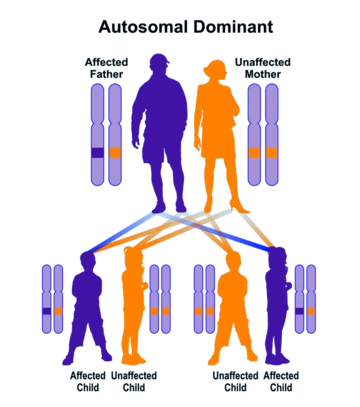
Autosomal dominant inheritance leads to a vertical pattern of transmission