


OMIM ID:
Craniofacial-Deafness-Hand Syndrome
Alternate Names
Defective Genes
Clinical Characteristics
Ocular Features
This rare syndrome has anomalies in periocular structures but not in the eye itself. The lid fissures are downward slanting with telecanthus and hypertelorism. The nasolacrimal duct was missing in several individuals.
Systemic Features
The midface is generally flat with underdeveloped maxillary bones and absent or small nasal bones but there may be frontal bossing. The nose appears hypoplastic with a broad, flat root resulting in dystopia canthorum. Micrognathia and a high arched palate are sometimes present. The sinuses are often underdeveloped. There may be ulnar deviation of the hands and fingers while flexion contractures and clinodactyly of the 5th finger are often present. A sensorineural hearing loss is present in many individuals. No poliosis has been reported.
Genetics
Inheritance
This is an autosomal dominant condition secondary to mutations in the PAX3 gene (22q36.1) in at least some patients. Changes in the same gene are responsible for types 1 and 3 of the Waardenburg syndrome (193500, 148820). In fact, the major mutation, a heterozygous C-to-G transversion, has been identified in the same codon in both CDHS and Waardenburg 3 (148820) patients.
More patients need to be genotyped to clarify the clinical features distinctive of Waardenburg types 1 and 3 (193500, 148820) and CDHS syndrome. Should we consider these conditions allelic or simply the result of variable expressivity? The appearance of the nasal root and associated structures is similar and both conditions are associated with sensorineural hearing loss. Type 3 Waardenburg syndrome (148820) often has a cleft palate and musculoskeletal deformities of the upper limbs and fingers. So far, no pigmentation changes have been reported in CDHS.
Pedigree
Autosomal dominant
Autosomal dominant disorders require only one mutation for the disease to be expressed. Since an affected parent has two chromosomes, only one of which has the mutant gene, parents can expect that half (50%) of their children will receive that one and inherit the disease. It is common for individuals that inherit the mutation, however, to not have evidence of the disease (nonpenetrance).
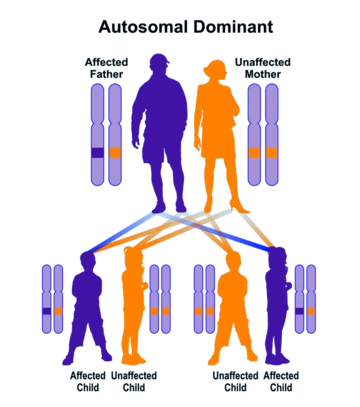
Autosomal dominant inheritance leads to a vertical pattern of transmission