


OMIM ID:
Corneal Dystrophy, Posterior Amorphous
Alternate Names
Defective Genes
Clinical Characteristics
Ocular Features
The iris abnormalities consisting of iridocorneal adhesions to Schwalbe’s line and pupillary abnormalities suggest that PACD is a congenital disorder, perhaps a form of anterior chamber dysgenesis. The corneal stroma and Descemet membrane contain sheet-like opacities with clear intervening areas. These opacities are concentrated in the posterior stroma and are sometimes seen from limbus to limbus whereas in other cases they occur mostly peripherally. The cornea may be thinner than normal and somewhat flattened. There is little or no progression of the corneal opacification and vision varies widely. Glaucoma has not been reported.
Histological and EM studies have revealed some fracturing and disorganization of the posterior stromal lamellae and focal attenuation of the endothelium.
Systemic Features
There is no associated systemic disease.
Genetics
Inheritance
A limited number of families with this disorder have been reported and the pattern in each is generally consistent with autosomal dominant inheritance. This may be a deletion syndrome based on the finding in a 1 year old African male with a heterozygous de novo deletion at 12q21.33-q22 containing 11 genes. Anong the missing genes are those for the 4 small leucine-rich proteoglycans associated with this form of corneal dystrophy. The parents did not have the deletion though.
Pedigree
Autosomal dominant
Autosomal dominant disorders require only one mutation for the disease to be expressed. Since an affected parent has two chromosomes, only one of which has the mutant gene, parents can expect that half (50%) of their children will receive that one and inherit the disease. It is common for individuals that inherit the mutation, however, to not have evidence of the disease (nonpenetrance).
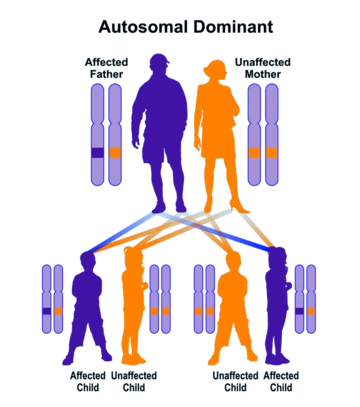
Autosomal dominant inheritance leads to a vertical pattern of transmission