


OMIM ID:
Corneal Dystrophy, Meesmann
Alternate Names
Defective Genes
Clinical Characteristics
Ocular Features
Meesmann corneal dystrophy is a disorder of the epithelium and its basement membrane. Onset is early, even in the first year of life and begins with irritation and often photophobia. However, some patients remain asymptomatic for many years. Vision is usually impacted only to a mild degree as a result of surface irregularities and epithelial cysts, which are concentrated most commonly in the interpalpebral regions. They may only be visible with slit lamp examination. The cysts are usually in the basal cells and are filled with PAS positive material. They may coalesce to form refractile lines and later in life become more opaque. The basement membrane appears coarse and is often abnormally thick. Bowman layer and the stroma are unaffected. Corneal sensitivity is reduced.
Stocker-Holt dystrophy (122100) is often lumped with Meesmann dystrophy and, while it is a clinically similar disease, it is usually caused by a different mutation. The 20 patients reported by Stocker and Holt in 1954 were descendents from Moravia who settled in North Carolina (Meesmann and Wilke's report in 1939 was based on patients in Holstein, Germany).
Systemic Features
No systemic disease is associated with this dystrophy.
Genetics
Inheritance
This is a genetically heterogeneous autosomal dominant disorder resulting from mutations in several genes encoding cornea-specific keratins, K12 by KRT12 (similar to Stocker-Holt dystrophy; 122100) and K3 by KRT3 (Meesmann dystrophy) located on chromosomes 17 (q12) and 12 (q13), respectively.
Pedigree
Autosomal dominant
Autosomal dominant disorders require only one mutation for the disease to be expressed. Since an affected parent has two chromosomes, only one of which has the mutant gene, parents can expect that half (50%) of their children will receive that one and inherit the disease. It is common for individuals that inherit the mutation, however, to not have evidence of the disease (nonpenetrance).
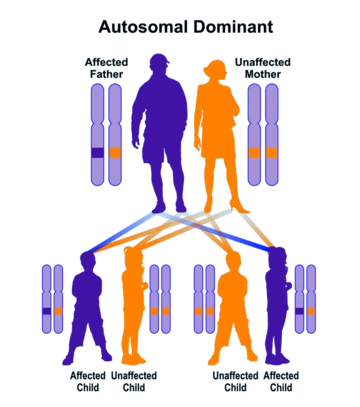
Autosomal dominant inheritance leads to a vertical pattern of transmission