


OMIM ID:
Corneal Dystrophy, Congenital Stromal
Alternate Names
Defective Genes
Clinical Characteristics
Ocular Features
This rare congenital form of stromal dystrophy is sometimes considered a disorder of collagen fibrils with abnormally small diameters. These may appear disorganized in areas. Corneal opacities are often evident at birth or during the neonatal period. Numerous small spots of fluffy, flaky deposits are found throughout the stroma creating a diffuse cloudy appearance and these may become more numerous with age indicating some progression. The epithelium, Descemet membrane and the endothelium are not affected and the stroma is of normal or slightly increased thickness. In some areas abnormal fibrillar layers are seen. Although corneal erosions and photophobia are usually not clinically significant, acuity may be as low as hand motions and penetrating keratoplasty may be indicated. In one series this was necessary at an average age of 20 years. In the same series of 11 patients, 4 had strabismus, 3 eyes developed open angle glaucoma and band keratopathy was present in one patient. Nystagmus has not been reported.
Deposition of abnormal decorin contributes to the stromal opacities.
Systemic Features
No systemic abnormalities have been reported.
Genetics
Inheritance
Pedigree
Autosomal dominant
Autosomal dominant disorders require only one mutation for the disease to be expressed. Since an affected parent has two chromosomes, only one of which has the mutant gene, parents can expect that half (50%) of their children will receive that one and inherit the disease. It is common for individuals that inherit the mutation, however, to not have evidence of the disease (nonpenetrance).
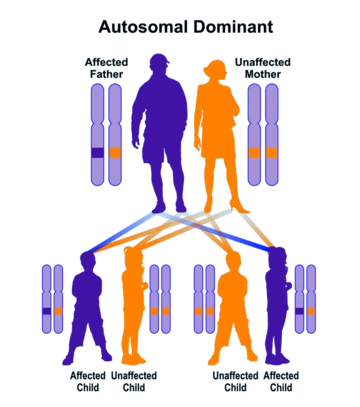
Autosomal dominant inheritance leads to a vertical pattern of transmission