


OMIM ID:
Corneal Dystrophy, Band-Shaped
Alternate Names
Defective Genes
Clinical Characteristics
Ocular Features
Symptoms of ocular irritation with tearing, conjunctival injection and decreased vision can be present at birth but more often is evident later in the first decade of life. The band is located in the cornea in the palpebral fissure area in a horizontal pattern. Apparently no other lesions are present in the eye.
Systemic Features
None reported.
Genetics
Inheritance
Only three families with familial, isolated band keratopathy have been reported. These were described in the mid-twentieth century and it is possible that they had underlying ocular and corneal disease. In one family 3 of 9 children, the product of a first-cousin mating, were affected consistent with autosomal recessive inheritance. In two of these the keratopathy was first noted during puberty while it was present at birth in the third child.
In another family the band keratopathy was seen in a brother and sister at 11 and 16 years old.
In the third family a father and son were affected.
Pedigree
Autosomal dominant
Autosomal dominant disorders require only one mutation for the disease to be expressed. Since an affected parent has two chromosomes, only one of which has the mutant gene, parents can expect that half (50%) of their children will receive that one and inherit the disease. It is common for individuals that inherit the mutation, however, to not have evidence of the disease (nonpenetrance).
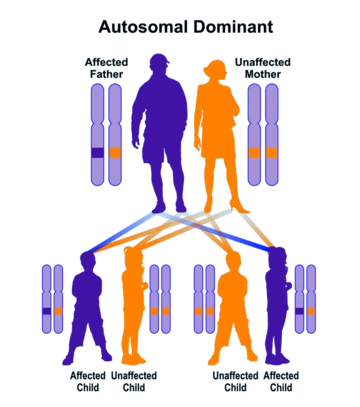
Autosomal dominant inheritance leads to a vertical pattern of transmission
Autosomal recessive
In order for autosomal recessive disorders to be expressed, offspring generally must inherit two mutations, one from each carrier parent. Carriers with only one mutation, such as the parents, do not have clinical disease. Note that carrier parents can expect that 1 in 4 children (25%) will inherit both mutations and have the disorder, 2 in 4 children (50%) will be carriers like their parents, while 1 in 4 children (25%) inherit neither mutation.

In order for autosomal recessive disorders to be expressed, offspring generally must inherit two mutations, one from each carrier parent. Carriers with only one mutation, such as the parents, do not have clinical disease. Note that carrier parents can expect that 1 in 4 children (25%) will inherit both mutations and have the disorder, 2 in 4 children (50%) will be carriers like their parents, while 1 in 4 children (25%) inherit neither mutation.