


OMIM ID:
Cone Dystrophy 3
Alternate Names
Defective Genes
Clinical Characteristics
Ocular Features
The evidence for the existence of pure cone dystrophies is inconclusive. Certainly some patients at least early in the disease seem to have pure cone dysfunction but eventually rod involvement becomes apparent. Loss of central acuity and color vision occurs in young adults between the ages of 20 and 40 years. Symptoms usually worsen with age and most patients eventually are legally blind. Photophobia is common. Pigmentary mottling in the retina may be evident before symptoms appear. Thinning of the retina, especially the macula, is seen late in the disease. Peripheral visual fields and rod function are often normal for many years although scotopic responses on the ERG eventually become attenuated.
Systemic Features
No systemic disease is associated with cone dystrophies.
Genetics
Inheritance
There is considerable genetic and clinical heterogeneity in photoreceptor disease. Heterozygous mutations in the GUCA1A (GCAP1) gene located at 6p21.1 seem to be responsible for this form of cone dystrophy, and inheritance therefore follows an autosomal dominant pattern. However, mutations in the same gene are also associated with macular dystrophy. The same region contains the RDS (PRPH2) gene which is also known to cause retinitis pigmentosa (608133) and fundus albipunctatus (136880). RDS (PRPH2) mutations have also been reported in some cases of so-called adult-onset vitelliform macular dystrophy (AVMD)(608161).
Another autosomal dominant cone dystrophy, RCD1, has been linked to a locus at 6q25-q26 but the gene has not yet been identified (180020). There is also a cone dystrophy with primarily peripheral involvement (609021).
Pedigree
Autosomal dominant
Autosomal dominant disorders require only one mutation for the disease to be expressed. Since an affected parent has two chromosomes, only one of which has the mutant gene, parents can expect that half (50%) of their children will receive that one and inherit the disease. It is common for individuals that inherit the mutation, however, to not have evidence of the disease (nonpenetrance).
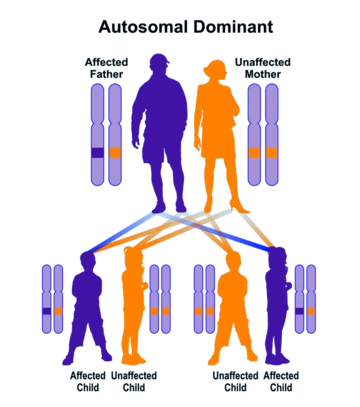
Autosomal dominant inheritance leads to a vertical pattern of transmission