


OMIM ID:
Colorblindness-Tritanopia
Alternate Names
Defective Genes
Clinical Characteristics
Ocular Features
A selective deficiency in blue (short wavelength) spectral sensitivity is characteristic of this disorder. Most patients retain the ability to see red and green colors although several patients with both defects have been reported. It seems to be a stable disorder with no evidence of progressive retinal dysfunction. ERG responses of long wavelength-sensitive cones are normal whereas those of blue-sensitive cones are undetectable. This selectivity distinguishes tritanopia from acquired forms of color blindness such as macular disease and rod-cone dystrophies in which there is generalized dysfunction among cones. However, there is wide variability in responses based on color vision testing suggesting that rudiments of blue-sensitive opsin function remain in some patients.
Systemic Features
There are no systemic abnormalities in this disorder.
Genetics
Inheritance
This is an autosomal dominant form of color blindness resulting from mutations in the OPN1SW gene located at 7q31.3-q32. Point mutations lead to defects in the blue-sensitive opsin protein.
Pedigree
Autosomal dominant
Autosomal dominant disorders require only one mutation for the disease to be expressed. Since an affected parent has two chromosomes, only one of which has the mutant gene, parents can expect that half (50%) of their children will receive that one and inherit the disease. It is common for individuals that inherit the mutation, however, to not have evidence of the disease (nonpenetrance).
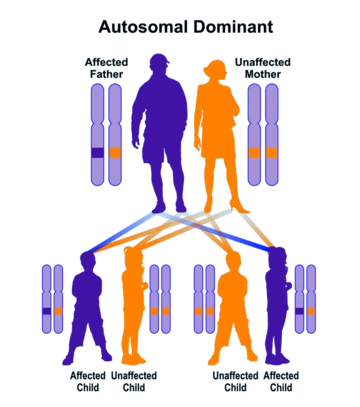
Autosomal dominant inheritance leads to a vertical pattern of transmission