


OMIM ID:
Choroidal Dystrophy, Central Areolar 1
Alternate Names
Defective Genes
Clinical Characteristics
Ocular Features
The primary feature of this form of macular dystrophy is atrophy of the RPE and choriocapillaris centralized to the macula. In early stages among young patients in the second decade of life, some pigment changes are seen in the parafoveal area. Later, the central macula develops hypopigmentation followed by atrophy of the choriocapillaris. The area is usually sharply defined but fluorescein angiography often shows multiple window defects beyond the edges. The same region often has speckled autofluorescence. Secondary dysfunction of the photoreceptors in this area leads to some mild degree of vision loss in adults between the ages of 30 and 60 years but this progressive disease may eventually result in legal blindness. The ERG demonstrates a cone dystrophy. The rate of disease progression is highly variable. Visual acuity varies considerably as does the appearance of the macula. Older individuals may be misdiagnosed as having age-related macular degeneration.
Systemic Features
There is no associated systemic disease.
Genetics
Inheritance
CACD1 is caused by a hterozygous mutations in GUCY2D gene localized to 17p13. One large three generation Irish family has been reported.
For a somewhat similar disorder see choroidal dystrophy, central areolar 2 (613105).
CACD is a genetically heterogeneous disorder with mutations in several genes responsible. The majority of patients have one of several mutations in the PRPH2 gene (6p21.1-cen) and the inheritance pattern seems to be autosomal recessive (CACD2). However, other family trees in which mutations in PRPH2 were excluded suggest autosomal dominant inheritance (CACD3; 613144) suggesting genetic heterogeneity such as the CACD1 condition described here.
Pedigree
Autosomal dominant
Autosomal dominant disorders require only one mutation for the disease to be expressed. Since an affected parent has two chromosomes, only one of which has the mutant gene, parents can expect that half (50%) of their children will receive that one and inherit the disease. It is common for individuals that inherit the mutation, however, to not have evidence of the disease (nonpenetrance).
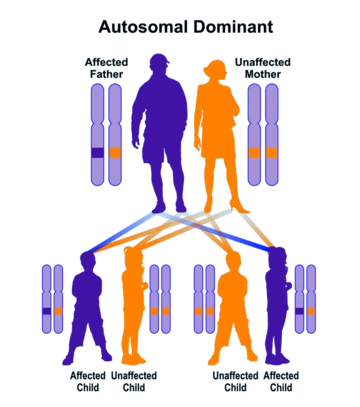
Autosomal dominant inheritance leads to a vertical pattern of transmission