


Clinical Characteristics
Ocular Features
Optic atrophy is present in some patients, particularly in X-linked recessive (CMTX5; 311070), X-linked dominant (CMTX5; 302800), and autosomal recessive (CMT2A2B; 617087) disease. Congenital and juvenile-onset open-angle glaucoma has been reported among members of 2 consanguineous families with type 4B2, or CMT4B2; (604563). The mean age of onset was 8 years.
Systemic Features
Charcot-Marie-Tooth disease is a large group of clinically and genetically heterogeneous disorders characterized by progressive motor and sensory polyneuropathy. These can be separated (with overlap) into two large groups on the basis of electrophysiologic criteria: type 1 is the demyelinating form, and type 2 the axonal form. Patients with primarily distal motor neuropathy are sometimes considered to comprise a third type.
Symptoms such as weakness in the extremities and digits have a variable age of onset but usually become evident in late childhood or early adulthood. Small muscles of the hands and feet are often atrophied to some degree. Some patients develop hearing loss of the neurosensory type. Foot deformities such as pes cavus are common. Nerve conduction velocity (reduction) and electromyography can be helpful diagnostically. It may be helpful to look for characteristic changes such as loss of myelinated fibers and focal myelin sheath folding in sural nerve biopsies. Intellectual impairment and dementia are usually not features of Charcot-Marie-Tooth disease.
Hemizygous individuals with X-linked types of CMT such as CMTX2-5 seem to be more likely to have intellectual disabilities, hearing loss, spasticity, and optic neuropathy.
Genetics
Inheritance
Charcot-Marie-Tooth disease can also be classified on the basis of their hereditary patterns including autosomal dominant, autosomal recessive, X-linked recessive, and X-linked dominant. Each of these contains yet more distinct subtypes as defined by mutations in at least 40 genes.
The wide range of disease severity and the overlapping of many signs can make pedigree construction and the determination of recurrence risks and prognosis challenging. The only recourse may be genotyping.
See Charcot-Marie-Tooth Disease with Glaucoma (604563) for a form of this disease in which glaucoma occurs early.
Pedigree
Autosomal dominant
Autosomal dominant disorders require only one mutation for the disease to be expressed. Since an affected parent has two chromosomes, only one of which has the mutant gene, parents can expect that half (50%) of their children will receive that one and inherit the disease. It is common for individuals that inherit the mutation, however, to not have evidence of the disease (nonpenetrance).
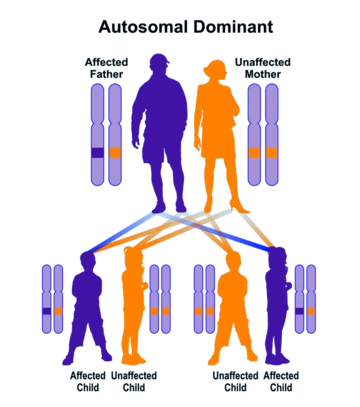
Autosomal dominant inheritance leads to a vertical pattern of transmission
Autosomal recessive
In order for autosomal recessive disorders to be expressed, offspring generally must inherit two mutations, one from each carrier parent. Carriers with only one mutation, such as the parents, do not have clinical disease. Note that carrier parents can expect that 1 in 4 children (25%) will inherit both mutations and have the disorder, 2 in 4 children (50%) will be carriers like their parents, while 1 in 4 children (25%) inherit neither mutation.

In order for autosomal recessive disorders to be expressed, offspring generally must inherit two mutations, one from each carrier parent. Carriers with only one mutation, such as the parents, do not have clinical disease. Note that carrier parents can expect that 1 in 4 children (25%) will inherit both mutations and have the disorder, 2 in 4 children (50%) will be carriers like their parents, while 1 in 4 children (25%) inherit neither mutation.
X-linked dominant, father affected
X-linked inheritance patterns result when disease-causing mutations are located on the X chromosome. Males have one X chromosome while females have two. A mutation on the male's X chromosome frequently is lethal or renders him unable to reproduce. However, in rare cases when males have children, they can expect that all of then will inherit the condition.

X-linked inheritance patterns result when disease-causing mutations are located on the X chromosome. Males have one X chromosome while females have two. A mutation on the male's X chromosome frequently is lethal or at least renders them unable to reproduce. However, in rare cases when males have children, they can expect that all of then will inherit the condition.
X-linked dominant, mother affected
X-linked inheritance patterns result from mutations located on the X chromosome. Females have two X chromosomes of which only one carries a mutation in X-linked dominant disorders. This usually results in expression of the disease and women with a single mutation have the disorder caused by the mutation. Half of their offspring, male and female, will inherit the mutation. Men, with only one X chromosome, will always have the condition if they inherit the one with the mutation. Men would transmit it to all of their offspring. Without a modifying normal gene on a second X chromosome, X-linked dominant conditions are frequently lethal in such males. The result is a vertical transmission pattern, usually from female to female.

X-linked inheritance patterns result from mutations located on the X chromosome. Females have two X chromosomes of which only one carries a mutation in X-linked dominant disorders. This usually results in expression of the disease and women with a single mutation have the disorder caused by the mutation. Half of their offspring, male and female, will inherit the mutation. Men, with only one X chromosome, will always have the condition if they inherit the one with the mutation. Men would transmit it to all of their offspring. Without a modifying normal gene on a second X chromosome, X-linked dominant conditions are frequently lethal in such males. The result is a vertical transmission pattern, usually from female to female.
X-linked recessive, carrier mother
X-linked disorders are caused by a mutation on the X chromosome and both sexes can pass this to their children. If the mutation is in a recessive gene and carried by the mother, she usually does not have the disease since the normal X chromosome without the mutation neutralizes the mutation in the abnormal X chromosome. However, half her sons will inherit the mutation-containing X chromosome and therefore have the X-linked disease. Half the daughters will inherit the mutation-bearing X chromosome and are usuallly healthy 'carriers'.

X-linked disorders are caused by a mutation on the X chromosome and both sexes can pass this to their children. If the mutation is in a recessive gene and carried by the mother, she usually does not have the disease since the normal X chromosome without the mutation neutralizes the mutation in the abnormal X chromosome. However, half her sons will inherit the mutation-containing X chromosome and therefore have the X-linked disease. Half the daughters will inherit the mutation-bearing X chromosome and are usuallly healthy 'carriers'.
X-linked recessive, father affected
X-linked disorders are caused by a mutation on the X chromosome and both sexes can pass this to their children. If the mutation is in a recessive gene and carried by the father, he has the disease since his only X chromosome is mutant and he has no normal X to blunt the effects of the abnormal gene. His sons only receive his Y chromosome and thus are all normal. However, all his daughters receive his one and only X chromosome and will be healthy 'carriers'. Thus such males will have no affected children but half their grandsons from those daughters will have the same disease as he does.

X-linked disorders are caused by a mutation on the X chromosome and both sexes can pass this to their children. If the mutation is in a recessive gene and carried by the father, he has the disease since his only X chromosome is mutant and he has no normal X to blunt the effects of the abnormal gene. His sons only receive his Y chromosome and thus are all normal. However, all his daughters receive his one and only X chromosome and will be healthy 'carriers'. Thus such males will have no affected children but half their grandsons from those daughters will have the same disease as he does.