


OMIM ID:
Cataracts, Lamellar
Alternate Names
Defective Genes
Clinical Characteristics
Ocular Features
This type of heritable cataract is progressive and has a variable phenotype both within and between families. It is usually seen bilaterally in early childhood but may be congenital in onset. Fine, dispersed, pulverulent opacities of the primary lens fibers are seen in the embryonic nucleus often with increased density at the ends of the Y suture at 12, 2, and 6 o'clock presenting a triangular appearance. However, the entire nucleus may be opaque as well. Zonular and posterior subcapsular opacities may appear later but there is considerable variation among patients and they may also appear in a stellate pattern. The lamellar pattern consists of a zone of opacification around a clear embryonic nucleus. There may be considerable difference in the rate of progression of the opacities among patients and even between the two eyes.
This may be among the most common type of congenital, autosomal dominant cataract. The first family was reported in 1878 and the family data has been updated and reported several times since then. The most recent reported pedigree consisted of 965 individuals in 9 generations. Among the 70 individuals added, 56 had cataract surgery performed between the ages of 1 month and 26 years with a mean of 8 years. However, some adults never had cataract surgery.
Another family with early onset, progressive, autosomal dominant cataracts mapping to the same locus has been reported (see Maumenee, 1979) but the opacification involves the secondary lens fibers at the posterior pole. These may be variants of the same condition.
Systemic Features
This is a non-syndromal cataract disorder and no systemic disease has been associated.
Genetics
Inheritance
This type of congenital cataract may be caused by mutations in the heat-shock transcription factor-4 gene (HSF4) located at 16q21-q22.1. It is inherited in an autosomal dominant pattern.
Another morphologically different autosomal dominant congenital cataract has been linked to the same locus (see Maumenee, 1979).
Other forms of autosomal dominantly inherited, congenital, progressive lens opacities include congenital cerulean (115660, 601547, 608983, 610202), Volkmann type (115665), Coppock-like (604307), and congenital posterior polar (116600) cataracts. Due to clinical heterogeneity, it is not always possible to classify specific families based on the appearance and natural history of the lens opacities alone.
Pedigree
Autosomal dominant
Autosomal dominant disorders require only one mutation for the disease to be expressed. Since an affected parent has two chromosomes, only one of which has the mutant gene, parents can expect that half (50%) of their children will receive that one and inherit the disease. It is common for individuals that inherit the mutation, however, to not have evidence of the disease (nonpenetrance).
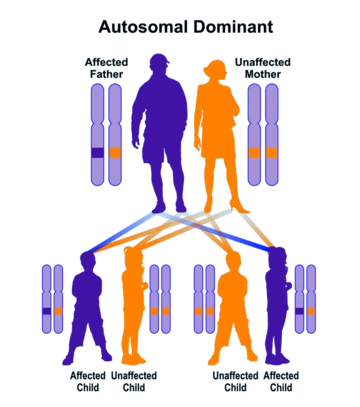
Autosomal dominant inheritance leads to a vertical pattern of transmission