


OMIM ID:
Cataracts, Congenital, Volkmann Type
Alternate Names
Defective Genes
Clinical Characteristics
Ocular Features
The nature of lens opacities is highly variable, ranging from dense opacification to barely detectable opacities. The opacities may be located in the embryonic, fetal and juvenile nuclei as well as around the Y sutures. They are congenital in origin and progressive. Minimal opacities can be asymptomatic early but all eventually require removal, usually by the first or second decades of life. Most cases have been reported from Denmark.
Systemic Features
No systemic disease is present.
Genetics
Inheritance
This type of cataract is inherited in an autosomal dominant pattern. The causative mutation is unknown but a presumed locus has been identified at 1pter-p36.13. This type of cataract may be allelic to congenital posterior polar cataract (116600).
Other forms of autosomal dominantly inherited, congenital, progressive lens opacities include congenital cerulean (115660, 601547, 608983, 610202), Coppock-like (604307), and lamellar (116800), cataracts. Due to clinical heterogeneity, it is not always possible to classify specific families based on the appearance and natural history of the lens opacities alone.
Pedigree
Autosomal dominant
Autosomal dominant disorders require only one mutation for the disease to be expressed. Since an affected parent has two chromosomes, only one of which has the mutant gene, parents can expect that half (50%) of their children will receive that one and inherit the disease. It is common for individuals that inherit the mutation, however, to not have evidence of the disease (nonpenetrance).
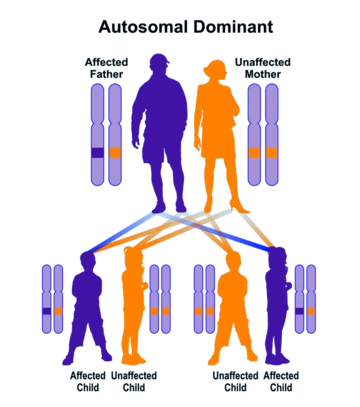
Autosomal dominant inheritance leads to a vertical pattern of transmission