


OMIM ID:
Cataracts, Congenital, Posterior Polar
Alternate Names
Defective Genes
Clinical Characteristics
Ocular Features
Posterior polar cataracts are likely to occur congenitally but there is often a delay in detection until childhood or even adolescence. Many patients with a late diagnosis develop nystagmus and strabismus. Opacification usually begins bilaterally as disc-shaped plaques of opacification in the posterior polar region and progresses relatively rapidly to complete opacification. Some patients require lens surgery in the first year of life while others not until they are young adults.
Systemic Features
This type of congenital cataract is not associated with systemic symptoms.
Genetics
Inheritance
Autosomal dominant posterior polar cataracts may result from mutations in the EPHA2 gene located at 1pter-p36.1. Interestingly, an area with a likely locus adjacent to but outside the coding region of this gene has been associated with age-related cataracts.
This type of lens opacity may be allelic to Volkmann cataract (115665).
Other forms of autosomal dominantly inherited, congenital, progressive lens opacities include congenital cerulean (115660, 601547, 608983, 610202), Coppock-like (604307), and lamellar (116800) cataracts. Due to clinical heterogeneity, it is not always possible to classify specific families based on the appearance and natural history of the lens opacities alone.
Pedigree
Autosomal dominant
Autosomal dominant disorders require only one mutation for the disease to be expressed. Since an affected parent has two chromosomes, only one of which has the mutant gene, parents can expect that half (50%) of their children will receive that one and inherit the disease. It is common for individuals that inherit the mutation, however, to not have evidence of the disease (nonpenetrance).
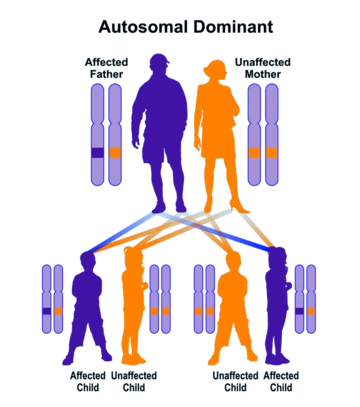
Autosomal dominant inheritance leads to a vertical pattern of transmission