


Clinical Characteristics
Ocular Features
A mother and 2 daughters with ectopia lentis, myopia, and blepharoptosis have been reported. The axial length of the globes was increased in the mother and one of the daughters while the myopia in the other daughter with ectopia lentis was presumably lens-induced as the equator bisected the visual axis (axial length approximately 25mm). The upper lid creases were considered to be abnormally high but levator function was good, consistent with levator aponeurosis disinsertion. Extraocular movements were normal.
Systemic Features
No systemic abnormalities were present. More specifically, there was no evidence of Ehlers-Danlos (225400) or Marfan syndrome (154700).
Genetics
Inheritance
The presence of similar findings in a mother and 2 daughters suggests autosomal dominant inheritance but no locus has been identified.
Pedigree
Autosomal dominant
Autosomal dominant disorders require only one mutation for the disease to be expressed. Since an affected parent has two chromosomes, only one of which has the mutant gene, parents can expect that half (50%) of their children will receive that one and inherit the disease. It is common for individuals that inherit the mutation, however, to not have evidence of the disease (nonpenetrance).
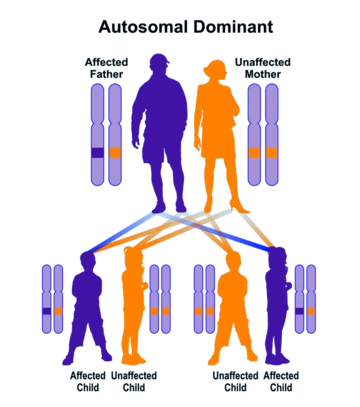
Autosomal dominant inheritance leads to a vertical pattern of transmission