


OMIM ID:
Baraitser-Winter Syndrome 2
Alternate Names
Defective Genes
Clinical Characteristics
Ocular Features
Hypertelorism, high arched eyebrows, ptosis, and colobomas occur in the majority of individuals.
Systemic Features
Short stature, postnatal microcephaly, lissencephaly, intellectual disability, seizures, and sensorineural hearing loss are common.
Genetics
Inheritance
This syndrome can be considered to be an autosomal dominant disorder secondary to heterozygous mutations in the ACTG1 gene (17q25.3). However, all patients have been sporadic.
Mutations in ACTG1 are also responsible for autosomal dominant progressive nonsyndromic hearing loss.
A similar but unique condition known as Baraitser-Winter syndrome 1 (243310) is caused by heterozygous mutations in the ACTB gene.
Pedigree
Autosomal dominant
Autosomal dominant disorders require only one mutation for the disease to be expressed. Since an affected parent has two chromosomes, only one of which has the mutant gene, parents can expect that half (50%) of their children will receive that one and inherit the disease. It is common for individuals that inherit the mutation, however, to not have evidence of the disease (nonpenetrance).
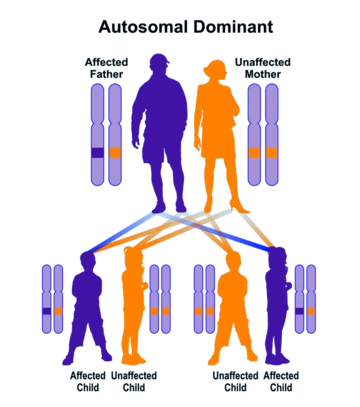
Autosomal dominant inheritance leads to a vertical pattern of transmission