


OMIM ID:
Albinism, Oculocutaneous, Type IV
Alternate Names
Defective Genes
Clinical Characteristics
Ocular Features
The ocular manifestations in type IV oculocutaneous albinism are similar to those of other types. Nystagmus, strabismus, misrouting of neuronal axons, and foveal hypoplasia are prominent features although there is some clinical heterogeneity among patients. Nystagmus may not be present at birth but is almost always evident by 3-4 months of age. The iris may be pale blue or tan and does not generally darken with age. Poor stereopsis is common. Vision is stable after childhood and usually in the range of 20/100-20/400.
Systemic Features
Hair color is generally intermediate between white and brown but many patients have only white hair and in others the hair is brown. Little darkening occurs as patients become older. The skin is often white or creamy yellow.
Genetics
Inheritance
This type of oculocutaneous albinism is one of the more common types found among Japanese and maybe Chinese individuals although it has also been reported in German and Turkish individuals. This is a rare autosomal recessive form of albinism caused by mutations in the MATP (SLC45A2) gene located at 5p13.3.
A single Japanese family with 16 affected members has been reported in which the transmission pattern was consistent with autosomal dominant inheritance. Heterozygous mutations in the SLC45A2 gene segregated appropriately.
Other types include OCA1 (203100, 606952 ), OCA2 (203200 ), OAC3 (203290), OAC5 (615179), and OCA6 (113750)..
Pedigree
Autosomal dominant
Autosomal dominant disorders require only one mutation for the disease to be expressed. Since an affected parent has two chromosomes, only one of which has the mutant gene, parents can expect that half (50%) of their children will receive that one and inherit the disease. It is common for individuals that inherit the mutation, however, to not have evidence of the disease (nonpenetrance).
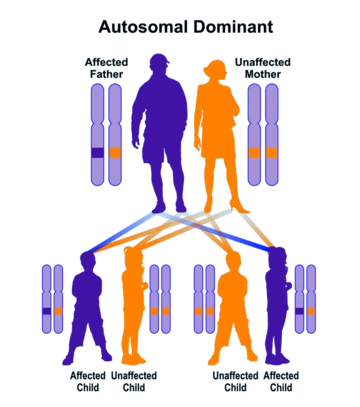
Autosomal dominant inheritance leads to a vertical pattern of transmission
Autosomal recessive
In order for autosomal recessive disorders to be expressed, offspring generally must inherit two mutations, one from each carrier parent. Carriers with only one mutation, such as the parents, do not have clinical disease. Note that carrier parents can expect that 1 in 4 children (25%) will inherit both mutations and have the disorder, 2 in 4 children (50%) will be carriers like their parents, while 1 in 4 children (25%) inherit neither mutation.

In order for autosomal recessive disorders to be expressed, offspring generally must inherit two mutations, one from each carrier parent. Carriers with only one mutation, such as the parents, do not have clinical disease. Note that carrier parents can expect that 1 in 4 children (25%) will inherit both mutations and have the disorder, 2 in 4 children (50%) will be carriers like their parents, while 1 in 4 children (25%) inherit neither mutation.