


OMIM ID:
Alagille Syndrome
Alternate Names
Defective Genes
Clinical Characteristics
Ocular Features
The ocular findings in Alagille syndrome are often of little functional significance but can be sufficient to suggest the diagnosis without further study of the systemic features. Posterior embryotoxon is found in 95% of individuals while iris abnormalities such as ectopic pupils are seen in 45%, abnormal fundus pigmentation is common (hypopigmentation in 57%, diffuse pigment speckling in 33%), and optic disc anomalies have been reported in 76%. One study found that 90% of individuals have optic disk drusen by ultrasonography. The anterior chamber anomalies are considered by some to be characteristic of Axenfeld anomaly. The presence of these ocular findings in children with cholestasis should suggest Alagille syndrome. Ocular examination of the parents can also be helpful in this autosomal dominant disorder as some of the same changes are present in one parent in more than a third of cases.
Systemic Features
A variety of systemic features, some of them serious malformations, occur in Alagille syndrome. Among the most common is a partial intrahepatic biliary atresia leading to cholestasis and jaundice. Skeletal malformations include ‘butterfly’ vertebrae, shortened digits, short stature, a broad forehead, and a pointed chin. The tip of the nose may appear bulbous. These features have suggested to some that there is a characteristic facial dysmorphology. Vascular malformations are common including aneurysms affecting major vessels, valvular insufficiency, coarctation of the aorta, and stenosis and these are often responsible for the most serious health problems. In fact, vascular events have been reported to be responsible for mortality in 34% of one cohort. Chronic renal insufficiency develops in a minority of patients. This disorder should always be considered in children with cholestasis, especially when accompanied by cystic kidney disease. Brain MRIs may show diffuse or focal hyperintensity of white matter even in the absence of hepatic encephalopathy.
Genetics
Inheritance
This is an autosomal dominant condition secondary to various mutations in the JAG1 gene located on chromosome 20 (20p12). Penetrance is nearly 100% but there is considerable variation in expression. A far less common variant of this disorder, ALGS2 (610205), is caused by a mutation in the NOTCH2 gene (1p13-p11).
Pedigree
Autosomal dominant
Autosomal dominant disorders require only one mutation for the disease to be expressed. Since an affected parent has two chromosomes, only one of which has the mutant gene, parents can expect that half (50%) of their children will receive that one and inherit the disease. It is common for individuals that inherit the mutation, however, to not have evidence of the disease (nonpenetrance).
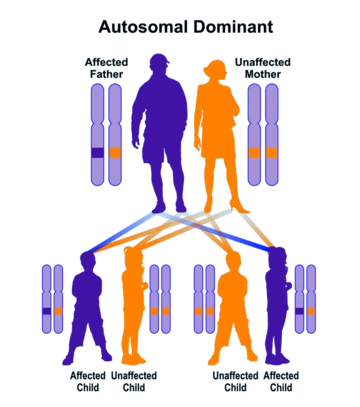
Autosomal dominant inheritance leads to a vertical pattern of transmission