


OMIM ID:
Adenomatous Polyposis of the Colon
Alternate Names
Defective Genes
Clinical Characteristics
Ocular Features
The ocular hallmark of this disease is the presence of congenital hypertrophy or hyperplasia of the retinal pigment epithelium (CHRPE). Singular lesions have little diagnostic significance and are not pathognomonic of FAP but the presence of 4 or more lesions is highly specific for the diagnosis of familial polyposis of the colon. Lesions are often teardrop-shaped and average between 4 and 5 mm in size. They are usually located in the midperiphery of the fundus and exhibit autofluorescence. Malignant changes in the form of adenocarcinomas have been reported but are rare.
CHRPE has been reported in the absence of colonic polyposis but has been reported in up to 90% of patients with some variant of FAP and is a highly sensitive marker.
Systemic Features
The signature non-ocular feature of this syndrome is the occurrence of numerous, sometimes thousands, of gastrointestinal polyps located mainly in the colon. Precancerous colonic polyps generally develop by the age of 16 years. Many of these eventually show malignant changes with colorectal cancer developing in nearly all patients by the sixth decade of life but the mean age of colon cancer diagnosis is at 39 years. Extracolonic lesions such as desmoid tumors, sebaceous cysts, osteomas, fibrosarcomas, and other tumors are frequently seen. Patients are also at higher risk of thyroid, adrenal, and liver cancer.
Dental anomalies, soft tissue tumors, and jaw osteomas are prominent features found in a variant of FPC known as Gardner syndrome.
Genetics
Inheritance
This is an autosomal dominant disorder resulting from mutations in the APC gene (5q22.2). This gene is a gatekeeper tumor suppressor gene which controls proliferation of colon epithelial cells. Loss or inactivation of APC is considered to be the basis of several cancer syndromes such as hereditary desmoid disease (135290), somatic gastric cancer (613659), and hepatocellular carcinoma (114550).
Pedigree
Autosomal dominant
Autosomal dominant disorders require only one mutation for the disease to be expressed. Since an affected parent has two chromosomes, only one of which has the mutant gene, parents can expect that half (50%) of their children will receive that one and inherit the disease. It is common for individuals that inherit the mutation, however, to not have evidence of the disease (nonpenetrance).
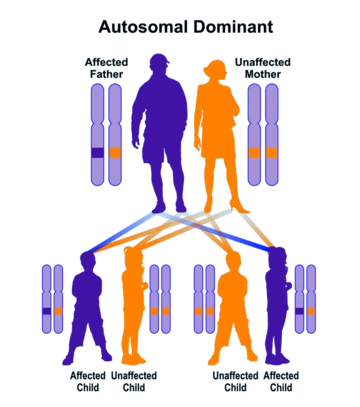
Autosomal dominant inheritance leads to a vertical pattern of transmission